^
^
^
^
^
^
^
^
^
2^
^
^
^
^
^
^
^
2^
^
11
^
^
^
^
^
^
^
^
^
^
^
2^
^
^
11
^
^
^
^
^
^
^
^
^
^
^
2^
^
^
^
^
^
^
^
^
^
^
^
2^
^
11
^
^
^
^
^
^
^
^
^
^
^
2^
^
^
^
^
^
^
^
^
^
^
^
2^
^
^
^
|
|
•
Can
AI Models Learn to Elude Human Control? Expert Says
'No'
SAN FRANCISCO, Calif., July 19,
2025 -- Citing concerns that the recent Wall Street Journal
article "AI Is Learning to Escape Human Control" could
distort the public's understanding of artificial
intelligence and fuel panic, leading AI expert Akli Adjaoute
is speaking
out.
••••
"AI remains a set of statistical
models governed by human-designed algorithms, data and
constraints. It cannot 'learn to escape' anything," Adjaoute
said. "These are computer programs, not sentient
entities."
••••
Adjaoute has more than three
decades of experience in the development and deployment of
mission-critical AI systems. He distills his educational and
professional expertise in his latest book, "Inside AI," in
which he provides a clear-headed, jargon-free overview of
the fascinating world of AI, including a chapter devoted to
answering a question in the minds of many: "Can machines
match or surpass human
creativity?"
••••
From those new to the field to
seasoned enthusiasts, Adjaoute aims to equip readers with a
comprehensive understanding of what AI truly is and what it
can and cannot
achieve.
••••
"There are many books written on AI,
but few that actually give readers a framework for how to
think about AI, and its transformational impact on every
person in the world," said Karen Webster, CEO at PYMNTS.
"This is that book. It is powerful in its simplicity, and
admirable for its accessibility."
Within the pages of Inside AI,
readers will gain practical insights, learning how
to:
· Understand
diverse AI techniques and methodologies
·
Draw lessons from both successful and failed AI
applications
·
Identify the capabilities and limitations of AI
systems
·
Grasp the successful and unsuccessful uses of AI in
business
·
Recognize areas where human cognition still surpasses
AI
·
Dispel common myths, such as AI's threat to jobs and
civilization
·
Effectively manage AI
projects
"As we progress, we'll also
address ethical questions surrounding bias, fairness,
privacy and accountability," Adjaoute added. "Drawing from
my three decades of experience in developing and deploying
mission-critical AI systems, I will outline the
characteristics that, in my perspective, will define the
next generation of AI platforms."
ABOUT THE AUTHOR
Akli Adjaoute is the founder of Exponion,
a venture capital firm that provides cutting-edge startup
companies with the financial resources and expertise they
need to achieve success. Before Exponion, Adjaoute was the
founder and CEO of Brighterion, which was acquired by
Mastercard in 2017. Brighterion has received multiple
awards, including the Innovation World Series Award, the
Morgan Stanley Fintech Award, the Business Intelligence
Group's 2022 Artificial Intelligence Excellence Award, the
U.S. FinTech Award's 2022 Banking Tech of the Year, the 2021
Business Transformation 150 and the 2020 Fortress Cyber
Security Award for Threat Detection.
Adjaoute holds 35 patents and has an
additional 50 patents pending approval. His inventions have
been cited over 2,000 times. He is a renowned academic,
speaker and writer in the fields of AI and security. He
served as an adjunct professor at the University of San
Francisco (USF) and as the Head of the AI department and
Scientific Committee Chair at EPITA, one of Europe's leading
institutions for engineering and computer science education.
He holds a master's degree in computer science from the
Université de Technologies de Compiègne and a
Ph.D. in artificial intelligence from the University of
Pierre & Marie
Curie.
•
Click for More
tviStory
102- Can AI Models Learn To Elude Human
Control
///
•
102-
Paramount+ With
SHOWTIME®
Officially Launched
•••
The launch adds Showtime's edgier
programming to the Paramount+ library. Paramount+ and
Showtime combined services into a unified SVOD platform
priced at $11.99 monthly starting June 27.
••••The
standalone Showtime platform will windup at the end of the
year. Paramount's ad-free service was priced at $9.99 per
month. The less expensive ad-supported option increased $1
to $5.99 and does not include Showtime.
••••Showtime
content joining Paramount+ includes "Your Honor,"
"Yellowjackets," "The Chi," "George & Tammy" "Dexter,"
"Billions," "Fellow Travelers," "The Curse," "The Woman in
the Wall," and "A Gentleman in Moscow," among others.
••••
"By adopting the programming of
Showtime onto the Paramount+ the platform has fortified
itself as the ultimate total household destination in
streaming," Tom Ryan, CEO of Streaming at Paramount, said in
a statement. "Together, these powerhouse brands will
showcase the breadth and depth of our content offering from
across Paramount. At this price point, we'll put the value
of the Paramount+ with Showtime plan up against any
other."
••••
Paramount ended the most recent
fiscal period with 60 million paid subscribers, which
included Showtime, Noggin and BET+.
///
• 102- Wheel
of Fortune' names Ryan Seacrest as new host, replacing Pat
Sajak

••••
June - 27, 2023. Weeks after longtime
Whell of Fortune host Pat Sajak announced his retirement,
Seacrest revealed Tuesday that he will takeover hosting
duties. The producer shared the news in a statement posted
on Instagram."
 "I'm truly humbled to be stepping
into the footsteps of the legendary Pat Sajak," he wrote. "I
can say, along with the rest of America, that it's been a
privilege and pure joy to watch Pat and Vanna
[White] on our television screens for an
unprecedented 40 years."
"I'm truly humbled to be stepping
into the footsteps of the legendary Pat Sajak," he wrote. "I
can say, along with the rest of America, that it's been a
privilege and pure joy to watch Pat and Vanna
[White] on our television screens for an
unprecedented 40 years."
••••
He added: "Pat, I love the way you've
always celebrated the contestants and made viewers at home
feel at ease. I look forward to learning everything I can
from you during this transition.
••••
The "Wheel of Fortune" change of
guard comes after Sajak said on Twitter that "his time has
come."
••••
"I've decided that our 41st season,
which begins in September, will be my last," he wrote. "It's
been a wonderful ride.
•••
Seacrest, who said he is "grateful"
for the opportunity," mentioned about how the move feels
"full circle" for him, as he reflected on one of his "first
jobs" hosting the short-lived game show "Click" from Merv
Griffin from 1997 to 1999. Griffin is a TV legend, having
created of both "Jeopardy!" and "Wheel of Fortune."
••••
"I can't wait to continue the
tradition of spinning the wheel and working alongside the
great Vanna White," Seacrest said.
•••During
his tenure hosting "Wheel of Fortune" alongside letter
turner Vanna White, Sajak has won the Daytime Emmy for
outstanding game show host three times, with 19 total
nominations. While Sajak will no longer be the face of
"Wheel," which he'd steered since its 1981 debut, Sony
Pictures Television confirmed that he will continue a
partnership with the program as a consultant.
••••
Seacrest has guided "American Idol"
from its inception, hosting the singing competition show
since 2002. Seacrest has proven a steadfast force on the
show as it transformed across the decade and judges cycling
in and out and amid its move from Fox to ABC.
 ••••
He is also well-versed in taking up
the mantle from another icon, after assuming hosting duties
for "American Top 40" from legendary radio host Casey Kasem
in 2004 and "Dick Clark's New Year's Rockin' Eve." Seacrest
co-hosted and executive produced the holiday special with
Clark from 2006 until the renowned broadcaster's death in
2012. ••••
He is also well-versed in taking up
the mantle from another icon, after assuming hosting duties
for "American Top 40" from legendary radio host Casey Kasem
in 2004 and "Dick Clark's New Year's Rockin' Eve." Seacrest
co-hosted and executive produced the holiday special with
Clark from 2006 until the renowned broadcaster's death in
2012.
••••
One of his first jobs was hosting a
little game show called 'Click' for Merv Griffin 25 years
ago so this is truly a full circle moment for me and "I'm
grateful to Sony for the opportunity," Seacrest added to his
post. "I can't wait to continue the tradition of spinning
the wheel and working alongside the great Vanna White."
••••
Seacrest's new gig comes just months
after he signed off as co-host of "Live With Kelly and
Ryan," where he worked for six years Kelly Ripa. The duo
experienced great success in the ratings. As of his final
shows, "Live" celebrated 29 consecutive weeks as the No. 1
syndicated talk show across all key Nielsen measures and in
2019, Ripa and Seacrest won a Daytime Emmy for outstanding
entertainment talk show hosts.
•••But,
departing "Live" reduced Seacrest's his six-job schedule a
year "Idol," "On Air With Ryan Seacrest," "American Top 40,"
"New Year's Rockin' Eve" and his morning show for L.A.'s
KIIS-FM radio)
•••The
TV host also put his focus to his food ventures. Seacrest
formed an agricultural company to study the process of
producing extra virgin olive oil and organic wine and will
be releasing his own label, dubbed "Concento, " and
launching new broadcast media centers in pediatric hospitals
with the Ryan Seacrest Foundation.
•
Click
for more
tviStory-102-
The Wheel of
Fortune named Ryan Seacrest to replace Pat
Sjak
•
102- SAG-AFTRA
on the Use of Artificial
Intelligence and Digital Doubles
in Media and Entertainment
LOS ANGELES (Mar. 17, 2023)
- SAG-AFTRA proudly supports the Human Artistry Campaign's
core principles for Artificial Intelligence Applications in
support of Human Creativity and Accomplishment and today
reaffirmed its position on digital voice, likeness and
performance simulations. The terms and conditions involving
rights to digitally simulate a performer to create new
performances must be bargained with the union. In addition,
any use or reuse of recorded performances is limited by our
collectively bargained contract provisions, including those
requiring consent and negotiation of compensation.
••••These
rights are mandatory subjects of bargaining under the
National Labor Relations Act. Companies are required to
bargain with SAG-AFTRA before attempting to acquire these
rights in individual performers' contracts. To attempt to
circumvent SAG-AFTRA and deal directly with the performers
on these issues is a clear violation of the NLRA.
••••Additionally,
Global Rule One, a fundamental principle of the union
stating that SAG-AFTRA members must always work under a
union contract anywhere they work, covers entering into any
agreement with an employer to digitally simulate a member's
voice or likeness to create a new performance. As such,
members should not assign these rights to any employer who
has not executed a basic minimum agreement with the
union.
••••Human
creators are the foundation of the creative industries and
we must ensure that they are respected and paid for their
work. Governments should not create new copyright or other
IP exemptions that allow AI developers to exploit creative
works, or professional voices and likenesses, without
permission or compensation. Trustworthiness and transparency
are essential to the success of AI.
••••SAG-AFTRA
will continue to prioritize the protection of our member
performers against the unauthorized use of their voices,
likenesses and performances. We are in frequent contact and
actively collaborate with other performers unions around the
world on these important issues. We follow the newest
developments in AI technology, its uses in the entertainment
and media industries, and the evolving legal landscape. We
will continue to negotiate and enforce provisions around
these technologies and their uses so employers and
performers can work collaboratively.
••••Members
who believe that employers are asking them to surrender AI
rights should email their agreement to
aiquestions@sagaftra.org. The union will investigate and
take appropriate steps to protect members based on the
specific circumstances. Please also email us with any
questions regarding authorizations, riders or improper
uses.
• SAG-AFTRA represents approximately
160,000 actors, announcers, broadcast journalists, dancers,
DJs, news writers, news editors, program hosts, puppeteers,
recording artists, singers, stunt performers, voiceover
artists, influencers and other entertainment and media
professionals. SAG-AFTRA members are the faces and voices
that entertain and inform America and the world. A proud
affiliate of the AFL-CIO, SAG-AFTRA has national offices in
Los Angeles and New York and local offices nationwide
representing members working together to secure the
strongest protections for entertainment and media artists in
the 21st century and beyond.
• Visit sagaftra.org online
•
Click
for More tviStory-102-
SAG-AFTRA on the Use Of Artificial Intelligence
(AI)
///
• 102-
BuzzFeed News shutting down as company cuts
staff
-
(Television Int'l
Magazine)
NEW YORK - April
20, 2023 -- BuzzFeed News, which won
a Pulitzer Prize for its reporting in 2021, is shutting
down, due to economic challenges facing digital media
companies attempting to deliver serious journalism.
••••
A memo from BuzzFeed chief Jonah
Peretti announced the closure Thursday in a staff memo,
which also said the New York-based company is cutting 15% of
its staff.
••••
"While layoffs are occurring across
nearly every division, we've determined that the company can
no longer continue to fund BuzzFeed News as a standalone
organization," Peretti said.
••••
BuzzFeed News, which once had as many
as 250 employees, has undergone significant staff reductions
in recent years, shrinking to a team of about 50.
••••
It used to be worth
$1.6 billion; no it's down to $100 million.
••••
BuzzFeed was founded in 2006 and its
news division launched in 2012. It was among the early
successful online-only media sites, continuing a model
established by Huffington Post, which BuzzFeed would later
acquire.
••••
BuzzFeed, similard to other online
news sites, has been hit by a deceleration in the
advertising business amid greater economic challenges. With
drops in advertising revenue, such companies have found
themselves unable to support big staffs. Mass layoffs seem
to have become so normal.
••••
Online news sites have also suffered
because major social media companies, including Facebook,
changed their algorithms, giving less focus to news
publishers. Facebook's thinking is that its users would
prefer to consume articles shared by friends. In addition,
Elon Musk's takeover of Twitter has made that site less
hospitable to news publishers.
•••
NPR and PBS stopped using Twitte
after receiving ''government funded' media label.
••••
Late
last week, Twitter labeled the radio broadcaster as a
"state-affiliated media" organization akin to foreign
propaganda outlets such as Russia's RT and Sputnik. The move
was quickly rebuked by NPR, which is publicly funded by
listeners. NPR CEO John Lansing called the label
"unacceptable." Twitter over the weekend updated the label
to "government-funded media."
••••
BuzzFeed News earned a Pulitzer Prize
in 2021 for an investigative series exposing China's mass
detention of Muslims.
••••
The outlet also won two prestigious
George Polk Awards, including for reporting how Facebook
facilitated, then failed to control, disinformation
spreading through its users' accounts, leading to
violence.
••••
The division was also known for
publishing an infamous dossier containing unflattering
information about former President Trump in 2017.
••••
BuzzFeed's content was aimed at a
younger demographic of digital natives who embraced the
company's stories designed to get traction on social
media.
•
Click
for More tviStory-102-
60
BuzzFeed News shutting down as company cuts
staff
///
•
102-
These Countries spend the most time
online
••••
Undoubtedly, we spend a significant portion of our day
online. But just how much?
••••
According to data presented by
the Atlas
VPN
team, the average time spent browsing
the internet in 2022 was 397 minutes (6 hours and 37
minutes) per day. It equates to an astonishing 2,415 hours
yearly, or nearly 30% of our time.
••••
However, there is some good news as daily online time
actually decreased by 4.8% or 20 minutes compared to 2021 as
we gradually moved past the pandemic.
••••
These figures are derived from data provided by Meltwater,
and We Are Social. The data looks at internet usage trends
worldwide among internet users aged 16 to 64.
••••
The time spent online varies significantly from country to
country. South Africans are the most internet-addicted, with
an average of 578 minutes (9 hours and 38 minutes) spent
online each day, three hours more than the global
average.
••••
Brazilians are just a little behind, with 572 minutes (9
hours and 32 minutes) devoted to internet usage daily. The
Philippines ranked third with an average of 554 minutes (9
hours and 14 minutes) spent online per day, followed by
Argentinians and Colombians, both with 541 minutes (9 hours
and 1 minute) of daily internet usage.
••••
People in the United States also spend an above-average
amount of time online, dedicating 419 minutes (6 hours and
59 minutes) daily to internet browsing &emdash; the same as
people living in Singapore. Meanwhile, Canadians are
slightly less generous with their time, spending an average
of 395 minutes (6 hours and 35 minutes) online daily.
••••
In contrast, East Asian countries have one of the lowest
average daily internet usage, with Chinese people spending
325 minutes (5 hours and 25 minutes) online, followed by
South Korea at 321 minutes (5 hours and 21 minutes), and
Japan with only 225 minutes (3 hours and 45 minutes)
&emdash; the least out of all the countries in the study.
The only exception is Taiwan, with an average daily internet
usage time of 434 minutes (7 hours and 14 minutes).
••••
Most European countries also spend significantly less time
online than the global average. Austrians devote 322 minutes
(5 hours and 22 minutes) daily to internet usage, while
Germans spend 312 minutes (5 hours and 12 minutes).
••••
People in Denmark dedicate the least amount of time to being
online out of all European countries in the study, with an
average of 298 minutes (4 hours and 58 minutes) spent on the
internet each day.
• Click
to read the full
article:
•
Click
for More tviStory-102-
Which Countries Spend Most Time
Online
///
•
102-YouTube
CEO Susan Wojcicki announces plan to stepp
down
MOUNTAINVIEW, Feb. 16, 2023 --
CEO Susan Wojcicki said that she's stepping down. Neal
Mohan, chief product officer, will take the lead as the
senior vice president and new head of YouTube.
••••
"Today, after nearly 25 years here,
I've decided to step back from my role as the head of
YouTube and start a new chapter focused on my family,
health, and personal projects I'm passionate about," she
said in a blog post.
••••
Wojcicki, 54, joined YouTube as CEO
in 2014.
••••
She will continue working with
YouTube teams, coaching members and meeting with creators,
she added.
••••
Wojcicki said she agreed with
Alphabet CEO Sundar Pichai to, in the longer term, take on
an advisory role across Google and Alphabet. "This will
allow me to call on my different experiences over the years
to offer counsel and guidance across Google and the
portfolio of Alphabet companies," she wrote.
••••
"The time is right for me, and I feel
able to do this because we have an incredible leadership
team in place at YouTube," she noted. "When I joined YouTube
nine years ago, one of my first priorities was bringing in
an incredible leadership team."
••••
Wojcicki has long-held ties to Google
founders Larry Page and Sergey Brin, who she let work out of
her Menlo Park, California, home upon founding Google. Page
and Brin rented the garage space for $1,700 a month
from her. At the time Wojcicki was working in the marketing
department at Intel.
••••
In 2006, she advocated for the $1.65
billion acquisition of YouTube.
••••
Wojcicki joined Google in 1999 and
oversaw the design and build of Google's advertising and
analytics products for 14 years. In recent years, YouTube
has expanded its physical footprint in areas like New York
and near its headquarters in San Bruno, California.
••••
During her tenure, she oversaw the
company's rapid expansion to become the largest video
platform in the world. YouTube now has more than 2.5 billion
monthly active users and more than 500 hours of content
are uploaded to the platform every minute,
the company has said.
••••
The rapid growth became a challenge
for the company to contain. Google and YouTube had to pay
$170 million in 2019 to settle a case where the video
platform allegedly violated children's privacy laws.
Wojcicki also came under fire during the 2020 elections and
the Covid-19 pandemic as the platform struggled to contain
misinformation and disinformation campaigns.
••••
Wojcicki's blog post said she spent
nearly 15 years of her career working with Mohan, the new
head of YouTube, "first when he came over to Google with the
DoubleClick acquisition in 2007 and as his role grew to
become SVP of Display and Video Ads."
••••
YouTube has faced pressure in recent
years amid a rise in popularity of social media, namely
TikTok, which it has been trying to compete with through its
short-form video platform Shorts. YouTube booked $7.96
billion in advertising revenue during the fourth quarter,
which fell short of analyst expectations and was down 8%
from the year prior.
•
Click for More tviStory-
102-YouTube
CEO Susan Wojcicki announces plan to stepp
down
///
•
102-Apple
warns of security flaw for iPhones, iPads and
Macs -
(AP)
 Apple disclosed serious security
vulnerabilities for iPhones, iPads and Macs that could
potentially allow attackers to take complete control of
these devices.
Apple disclosed serious security
vulnerabilities for iPhones, iPads and Macs that could
potentially allow attackers to take complete control of
these devices.
••••
Security flaw may allow hackers full
control of devices, company warns. Apple has released
patches for major iOS and macOS security breaches. Major
security vulnerabilities found in iOS and macOS devices
could allow potential hackers complete control of a user's
device, Apple warned on Wednesday
••••
The company said it is "aware of a
report that this issue may have been actively
exploited."
••••
Apple did not say in the reports how,
where or by whom the vulnerabilities were discovered. In all
cases, it cited an anonymous researcher.
••••
Apple released two security reports
about the issue Wednesday, although they didn't receive wide
attention outside of tech publications.
••••
Security experts have advised users
to update affected devices -- the iPhones 6S and later
models; several models of the iPad, including the 5th
generation and later, all iPad Pro models and the iPad Air
2; and Mac computers running MacOS Monterey. It also affects
some iPod models.
••••
Apple's explanation of the
vulnerability means a hacker could get "full admin access to
the device" so that they can "execute any code as if they
are you, the user," said Rachel Tobac, chief executive of
SocialProof Security.
••••
Those who should be particularly
attentive to updating their software are "people who are in
the public eye" such as activists or journalists who might
be the targets of sophisticated nation-state spying, Tobac
said.
••••
Commercial spyware companies such as
Israel's NSO Group are known for identifying and taking
advantage of such flaws, exploiting them in malware that
surreptitiously infects targets' smartphones, siphons their
contents and surveils the targets in real time.
••••
NSO Group has been blacklisted by the
U.S. Commerce Department. Its spyware is known to have been
used in Europe, the Middle East, Africa and Latin America
against journalists, dissidents and human rights
activists.
••••Security
researcher Will Strafach said he had seen no technical
analysis of the vulnerabilities that Apple has just patched.
The company has previously acknowledged similarly serious
flaws and, in what Strafach estimated to be perhaps a dozen
occasions, has noted that it was aware of reports that such
security holes had been exploited.
•
Click
for More tviStory-
102- s90-
Apple
warns of security flaw for iPhones, iPads and
Macs
///
•
102-
NAB AMPLIFY inspires global
media
NOW AVAILABLE ON DEMAND are 25 of
the most popular sessions from this year's NAB 2022 Show
conference program.
••••
Catch up or re-watch any of these
themed tracks--each collection contains five highly
informative, curated sessions for a view into the
conversations that could only happen at NAB Show.
••••
Access passes are $50 per
collection. That's only $10 per session!
CREATIVE WORKFLOWS
• The Future of Production and the Content It
Creates
• Creative Camera Conversations: "Nightmare Alley"
• Remote Collaboration: "The Making of Everything
Everywhere All At Once"
• The Future of Filmmaking
• Future of Cinema: Technology Enablers
FUTURE OF CONTENT DELIVERY
• Future of Cinema: Immersive Experiences & Use
Cases
• Future of Cinema: Beyond the Big Screen
• Hollywood's "Binge Times" OTT Battle and NAB
Engineering Awards
• Reimagining the Content Experience
• Future Proofing Content Experiences and Audience
Engagement
FUTURE OF TV
• BEIT Conference Opening Session
• ATSC 3.0 / Next Gen TV Applications
• It's Not TV, It's Data-Driven TV
• Building a Great Entertainment Brand
• Insights from The Futurists
WEB3 AND THE METAVERSE
• What's ATSC 3.0 Got to Do with Web 3.0 and the
Metasphere? or Next Gen TV Beyond 5G/6G
• A Whole New World: Diving into the Metaverse
• Capitalizing on Hollywood Technology
• The Year That Changes Everything: How Web3 Will
Evolve Media & Entertainment
• Meet the Game Viewing Audience
VIRTUAL PRODUCTION
• Virtual Production for Indie Filmmakers
• Out of this World: Virtual Production on Roninfilm's
"Gods of Mars"
• The Future is Now: Telling Creative Stories with
Technology on The Weather Channel
• Final Pixel: Fantasy Filmmaking with Virtual
Production
• World Building: Inside Mixed Reality for Live
Broadcast
• Click
More
• Click
for More tviStory-
102-s90-
• AMPLIFY
NAB
///
•
102-
Former US President Donald Trump has announced plans to
launch a new social media network, called TrumpTRUTH
Social.
••••
He said the platform would "stand up to the tyranny
of big tech," accusing them of silencing opposing voices in
the US. •
•••• Social
media played a pivotal role in Mr Trump's bid for the White
House and was his favorite means of communication as
president.
•••• But Mr
Trump was banned from Twitter and suspended from Facebook
after his supporters stormed the US Capitol.
•••• Since
then he and his advisers have hinted that they were planning
to create a rival social media site.
••••Earlier
this year, he launched "From the Desk of Donald J Trump,"
which was often referred to as a blog.
••••The
website was permanently shut down less than a month after it
launched after attracting only a fraction of the audience he
would have expected through established sites.
••••An
early version of his latest venture, TRUTH Social, will be
open to invited guests next month, and will have a
"nationwide rollout" within the first three months of 2022,
according to a statement by Trump Media & Technology
Group (TMTG)
••••"Everyone
asks me why doesn't someone stand up to Big Tech? Well, we
will be soon!" he added.
••••There's
no indication that the new company has a working platform
yet. The new site is just a registration page.
•••• He
wants to create a platform that rivals Twitter or Facebook,
but by its very nature the platform is overtly politicised.
It is not going to be a talking shop of ideas like Twitter,
or a place the whole family is on like Facebook.
•••• What
it could be is a more successful version of other 'free
speech' social media platforms like Parler or
Gab.
••••
Donald Trump clearly wants his megaphone back. He
thinks this might be his ticket. But if he's really going to
be heard, he needs the Big Tech platforms to let him back
on.
•••••
TMTG, which he chairs, also intends to launch a subscription
video-on-demand service. TMTG said its video-on-demand
service would "feature 'non-woke' entertainment programming,
news, podcasts, and more".
///
•
102- Hacked streaming accounts on the dark
web
By Brent
Shelton
••••
NordVPN in teamed
with cybersecurity researchers to discover stolen data
records from 16 million computers worldwide, including
credentials from Netflix and Spotify users.
••••
What has been stolen?
174,800 streaming credentials were stolen and are now being
sold online--61% were from Netflix users, 25% Spotify, 7%
Amazon Prime and others from Hulu, Vimeo, and
Disney+.
••••
Who got affected the
most? Half a million American internet users and more than a
third of a million Canadians managed to download and install
the malware that stole their credentials.
••••
What happens to
stolen accounts? Hackers commonly share streaming service
credentials on the dark web for free, and eBay and other
classifieds offer to get access to a streaming service for
half the price.
••••
"Stolen login
credentials to streaming services are just a fraction of
what has been leaked. Unencrypted files ended up on the dark
web too. Customers can prevent this by using protection
tools like NordLocker that encrypt data and keep it safe in
the cloud," says Daniel Markuson, digital privacy expert at
NordVPN.
•
Click
for More
Cybersecurity researchers discovered 175K leaked
streaming service accounts. Damages might total $38M.
••••
NordVPN in cooperation with
cybersecurity researchers found stolen data records from 16
million computers worldwide. The data ended up on the dark
web after the computers got infected with Zeus, Pony
Stealer, RedLine, Raccoon, and dozens of other types of
malware built specifically for capturing login credentials
saved on computers. As a result, 174,800 content streaming
accounts ended up on the market for a
resale.
What has been stolen?
"If you have ever saved your credentials in a browser,
including your streaming service logins, your home address,
or, even worse, your credit card data, malware like Zeus,
Pony Stealer, RedLine, or Raccoon would take it all. More
than that, bad actors also get information about your
usernames, location, and hardware configurations and might
take control over your device. Malware like that is not easy
to get. It's sold underground on a subscription basis,"
Daniel Markuson warns.
•••
Researchers estimate that the damage
inflicted on users of streaming services alone could round
up to $38M*. Netflix users suffered the most: 61% of all
stolen streaming credentials are associated with one of the
most popular streaming platforms online. It is followed by
Spotify (25%) and Amazon Prime (7%). Combined with Hulu,
Vimeo, and Disney+, 174,800 thousand accounts have been
stolen and are now being sold online.
Who got affected the most?
According to NordVPN researchers, half a million
American internet users and more than a third of a million
Canadians managed to download and install the malware that
stole their credentials.
•••"One
day, these people will find themselves locked out of their
accounts, unable to access it because the account got sold,
its password changed, and the initial email associated with
it replaced," says Daniel Markuson, digital privacy expert
at NordVPN.
•••Yet,
users from the US and Canada are not the ones who were
affected the most. As many as 1.8M Indonesians got their
data stolen and leaked, and the country alone represents
11.4% of all infected devices in the world. India, Brazil,
and Argentina come next, with 1.2M computers affected
each.
•••Malware
that extracted information from 16M internet users worldwide
is built to harvest information from
browsers.
INSERT GRAPH
List of the top 20 countries by the number of computer users
affected by the data leak the cybersecurity researchers
discovered
What happens to stolen Netflix
accounts?
Streaming service accounts are a very common exchange
unit on the dark web. Daniel Markuson, digital privacy
expert at NordVPN, says he has observed hackers simply
sharing it for free, as it takes almost no effort to obtain
them. On the other hand, eBay and other classifieds are full
of offers to get access to a streaming service for half the
price.
•••One
listing on eBay reads: "Netflix Account Premium 4K ultra HD
4 Screens 12 Months. Instant delivery within 1min to
12hours Worldwide. You can Change your password, your email
and your phone number. Work on your TV, computer, smartphone
and tablet." The price for the stolen annual subscription is
US $19.99, when the official one cost $215.88.
•••"There
is no doubt such accounts came from leaked computer data or
acquired through other illegal activities. People who think
it's a good idea to spend your money on that are
contributing to theft," says Daniel
Markuson.
How to protect your data from being
stolen and streaming service accounts from being taken
over?
Netflix and other streaming services accounts found by
the cybersecurity researchers got leaked after users
injected their computers with malware by clicking on a link
or file distributed via email or private messaging apps.
•••Such
attacks often succeed for two reasons: lax cybersecurity
protections and human error. Criminals prey on urgency and
deceit. People think they are clicking on a link or opening
an attachment from a trusted source provided in an email.
Once they do, malware code gets executed on their device and
secretly starts draining data from the victim's computer.
"Before opening any link or any attachment whatsoever, one
must be 100% sure it's legitimate," Daniel Markuson
warns.
•••According
to the cybersecurity expert, "Another issue is that people
barely use cybersecurity protections like VPN and antivirus.
And, if they do, they fail to keep them up to date. The
combination of the two could block the way to malware
installation."
•••"What
people must understand is that the stolen login credentials
to streaming services are just a fraction of what has been
leaked. Unencrypted files ended up on the dark web too. The
best way to prevent this from happening to you is to start
using protection tools like NordLocker that encrypt data and
keep it safe in the cloud. Without a decryption key this
information is useless," the privacy expert adds.
•••Methodology:
The insights were compiled in partnership with a third-party
company specializing in data breach research. They evaluated
a database that contained information leaked from 16 million
computers in total. * Damages calculated based on the
most popular streaming service premium plan price for 12
months.
ABOUT NORDVPN
NordVPN is the world's most advanced VPN service provider
that is more security-oriented than most VPN services. It
offers double VPN encryption, malware blocking, and Onion
Over VPN. The product is very user-friendly, offers one of
the best prices on the market, has over 5,000 servers
worldwide, and is P2P-friendly. One of the key features of
NordVPN is the zero-log policy. For more information:
nordvpn.com.
///
•
102-
Virtual summit to rethink the
future
REUTERS NEXT kicks off 2021 by
gathering global leaders and forward thinkers to reimagine
solutions to the challenges the new year brings.
••••
After the extraordinary upheavals of
2020, conference participants will take look ahead at
opportunities for change and growth, as well as how to deal
with the rifts and problems that our world an our societies
face.
••••
No country, company or community
can?tackle the future alone. To build a better world,
thinkers and doers must come together to share ideas,
collaborate and act.
••••
REUTERS NEXT draws on Reuters
global reach to host diverse voices from around the world
who will examine topics from different perspectives,
bringing their passion, experience and expertise to find new
ways forward.
Virtual Forum will take place on January 11-14. 2021.
•
Click
for More
tviStory- 102-s90-REUTERS
NEXT- Virtual
summit to rethink the
future
///
•
30th
Anniversary of the World Wide
Web
••••
In 1989 the world's largest physics laboratory, CERN was a
hive of ideas and information stored on multiple
incompatible computers. Tim Berners-Lee envisioned a
unifying structure for linking information across different
computers and wrote an proposal in 1989 called "Information
Management: A Proposal." By 1991 this vision of universal
connectivity had become the Word Wide Web.
"Suppose all information
stored on computers everywhere were linked . Suppose I could
program my computer to create a space in which everything
could be linked to everything."
Tim Berners-Lee, inventor of the World Wide Web
••••
Tim Berners-Lee wrote the first web
browser in 1990 while employed at CERN near Geneva,
Switzerland. The browser was released to the general public
in August 1991. The World Wide Web has been central to the
development of the Information Age and is the primary tool
billions of people use to interact on the
Internet.
••••
"Vague but exciting." This was how Sir Tim Berners-Lee's
boss responded to his proposal titled "Information
Management: A Proposal," submitted on March 12 in 1989, when
the inventor of the World Wide Web was a 33-year-old
software engineer. Initially, Berners-Lee envisioned "a
large hypertext database with typed links,"named
"Mesh," to help his colleagues at CERN (a large
nuclear physics laboratory in Switzerland) share information
amongst multiple computers.
••••
Berners-Lee's boss allowed him time
to develop the humble flowchart into a working model,
writing the HTML language, the HTTP application, and
WorldWideWeb.app-- the first Web browser and page editor. By
1991, the external Web servers were up and running.
••••The
Web would soon revolutionize life as we know it, ushering in
the information age. Today, there are nearly 2 billion
websites online. Whether you use it for email, homework,
gaming, or checking out videos of cute puppies, chances are
you can't imagine life without the Web.
••••Not
to be confused with the internet, which had been evolving
since the 1960s, the World Wide Web is an online application
built upon innovations like HTML language, URL "addresses,"
and hypertext transfer protocol, or HTTP. The Web has also
become a decentralized community, founded on principles of
universality, consensus, and bottom-up design.
••••"There
are very few innovations that have truly changed
everything," said Jeff Jaffe, CEO of the World Wide Web
Consortium. "The Web is the most impactful innovation of our
time."
••••
Happy 30th Anniversary to the World
Wide Web! - Google
•
Click
for More tviStory
102--30
Years of the World Wide
Web
///
•
102-France
To Sanction Google
for online snippets of press articles on Google
News.
France has accused American
Internet giant Google of ignoring "the spirit and the
letter" of a Europe-wide copyright law aimed at giving
publishers a bigger cut of the economic benefit from online
news.
••••
French President Emmanuel Macron and the country's lawmakers
say they are now looking to sanction Google for adopting
what they consider strongarm tactics to avoid paying to
publish excerpts from European publications on Google
News.
••••
France is the first European country to put the European
Union's Directive on Copyright in the Digital Single Market
on its statute books, taking effect at the end of October.
The European Parliament adopted the directive in March,
giving member states two years to pass legislation upholding
its requirements.France's law requires Google to pay what
has been called a "link tax" -- effectively a license to
display snippets of press articles on Google News.
••••
Google responded to the law's passage by announcing it would
stop displaying previews of news articles and use only a
headline and link. The company said French publishers could
still ask for snippets to be published, but it would not pay
for the right. Google says it sends 8 billion visitors a
month to publishers' sites in Europe alone.
••••
"Publishers have always been able to decide whether their
content is available to be found in Google Search or Google
News," Google wrote in a blog post. "The Internet has
created more choice and diversity in news than ever before.
With so many options, it can be hard for consumers to find
the news they are interested in. And for all types of
publishers ... it's important to make sure readers can find
their content."
••••
Google's announcement brought an angry riposte from Macron,
who told journalists on Wednesday he would be asking
Europe's competition authorities to examine the move and to
"engage in any possible action as soon as possible".
••••
"Certain companies like Google now want to get around the
rules. We will not let them do this," Macron said. His
comments came after he and German Chancellor Angela Merkel
issued a joint statement to the same effect following a
meeting of French and German ministers on Wednesday.
••••
The French competition authority announced at the end of
September it would be looking into Google's actions, but
said it was only an "exploratory" inquiry at this stage. It
could not say if or when legal action might be taken against
the American internet giant.
••••
France's culture minister, Franck Riester, has described the
EU directive as "absolutely essential for our democracy and
the survival of an independent and free press." He said
Paris and Berlin were ratcheting up their response after he
met Google executives Patrick Jabal, vice president in
charge of partnerships, and Cécile Frot-Coutaz,
director of YouTube for Europe and Africa, in New York last
Saturday.
••••
"It enabled me to restate France's position and to
understand that they still have difficulty sharing the
benefits as the law outlines. That's why we need to be even
more determined," Riester said afterward.
••••
Riester had already declared Google's move "unacceptable,"
saying the object of the law was to "allow a fairer sharing
of the profits the platforms make using press content."
••••
"Unilateral declarations of the rules is contrary to both
the spirit and the letter of the directive," Riester said,
calling for a "proper global negotiation between Google and
publishers."
••••
David Assouline, a French senator who helped draft the
French law, tweeted that Google should "have more respect
for France by applying the law instead of trying to get
around it."
••••
Prior to its adoption in March, Google and other key
internet players lobbied heavily against the EU directive.
The most controversial articles in the final directive are
article 15, which forces search engines and aggregated news
platforms to pay for the snippets they use from other
publications, and article 17, which makes internet giants
including Google and YouTube responsible for material they
publish without copyright permission and slaps penalties on
them if they fail to block content that infringes
copyright.
••••••
In a letter to the president of the European parliament last
year, Tim Berners-Lee, the inventor of the worldwide web,
and 70 other web pioneersdescribed the EU's directive on
copyright as a "threat to the future of this global
network."
••••
"As creators ourselves, we share the concern that there
should be a fair distribution of revenues from the online
use of copyright works, that benefits creators, publishers,
and platforms alike. But Article 13 is not the right way to
achieve this." The signatories called the automatic content
filtering requirement "an unprecedented step towards the
transformation of the Internet from an open platform for
sharing and innovation, into a tool for the automated
surveillance and control of its users."
By
By Kim
Willsher
•
Click
for More tviStory
102--France
To Sanction Googles
///
•
102-More
EU rules for Facebook on hateful posts
Facebook must remove hateful posts worldwide, top
EU court rules
By BLOOMBERG
••••
Facebook Inc. can be forced to remove
posts anywhere in the world to protect European Union users
from hateful content, the bloc's highest court ruled in a
case that widens a chasm with the U.S. on freedom of speech
and privacy.
••••
European courts can force platforms
such as the social-network giant to seek and destroy such
content once they've been alerted, the EU judges said in a
binding decision on Thursday. Courts can also order a
worldwide removal as long as they take international law
into account when they issue the edicts, the judges
said.
••••
"Today's ruling essentially allows
one country or region to decide what internet users around
the world can say and what information they can access,"
said Victoria de Posson, senior manager in Europe at the
Computer & Communications Industry Assn., an industry
group that includes Alphabet Inc.'s Google and Facebook as
members.
••••
The EU has taken a tougher stance on
citizens' online rights than elsewhere in the world. In
2014, the EU's top court gave people a so-called right to be
forgotten, allowing them to ask Google to remove European
links to websites that contain out-of-date or false
information that could unfairly harm a person's reputation.
Still, in contrast to Thursday's judgment, the same court
decided last month against requiring search engines to scrub
links globally.
••••
"What might be considered defamatory
comments about a politician in one country will likely be
considered constitutional free speech in another. Few
hosting platforms, especially startups, will have the
resources to implement elaborate monitoring systems," de
Posson said.
••••
Platforms from Facebook to Google's
YouTube won a nod of approval from the EU earlier this year
for tackling hate speech posted online as part of a code of
conduct signed with the commission in 2016. The companies
vowed to tackle online hate speech within 24 hours, once
made aware of it.
••••
Facebook said the ruling goes beyond
a process it already follows to "restrict content if and
when it violates local laws."
••••
The judgment "undermines the
long-standing principle that one country does not have the
right to impose its laws on speech on another country,"
Facebook said in an emailed statement. "It also opens the
door to obligations being imposed on internet companies to
proactively monitor content and then interpret if it is
'equivalent' to content that has been found to be
illegal."
••••The
EU court decided that in some cases platforms can be ordered
not just to remove identical content, but also posts that
are equivalent to such hateful and illegal ones. According
to Facebook and human rights group Article 19, this risks
trampling on people's fundamental rights.
••••
"Compelling social media platforms
like Facebook to automatically remove posts regardless of
their context will infringe our right to free speech and
restrict the information we see online," said Thomas Hughes
of Article 19. "The judgment does not take into account the
limitations of technology when it comes to automated
filters."
••••
In contrast to the U.S. where freedom
of speech is a constitutional right, Europe has
traditionally placed more limits on what people publish,
forbidding Holocaust denial in Germany, for instance. That
chasm is widening as Europe is becoming more aggressive in
combating hate speech online to prevent violent attacks
against groups, like the terrorist shootings at mosques in
Christchurch, New Zealand, in March.
••••
Despite the platforms' efforts, EU
officials have been mulling new bloc-wide rules, building on
existing legislation in Germany, that could hit big tech
firms with possible fines if they fail to remove illegal
hate speech quickly enough. The discussions fit into broader
plans by the EU to overhaul liability rules for
platforms.
••••
Austria's Supreme Court last year
sought the EU judges' guidance in a dispute between Facebook
and Eva Glawischnig-Piesczek, a former Green member of the
European Parliament, who was the subject of a number of
offensive posts on a Facebook user's account. She asked for
an order against the company to block any further
publications of pictures of her if the text alongside them
included similarly offensive content.
••••
The Austrian court also asked whether
under EU law companies could be forced to remove any content
from its platform "with an equivalent meaning" to illegal
information it has been made aware of. Lawyers said this is
an issue also faced by copyright owners on platforms such as
YouTube, or Instagram, where uploads of previously
taken-down copies keep popping up online.
••••
"We hope the courts take a
proportionate and measured approach, to avoid having a
chilling effect on freedom of expression," said Facebook in
its statement.
///
• 115-
The future of aircraft interiors at the Aircraft Interiors
Expo
Aircraft Interiors Expo Los Angeles is where
the innovators meet the decision-makers, with everything
designed to give you a first class experience. The fall's
global meeting place for the passenger experience
industry
will take place at the Los
Angeles convention Center, September 10 -
12.
••••
The Aircraft Interiors Expo Los Angeles is the fall event
for airlines and the supply chain to network and source the
latest innovations and it provide the perfect environment to
target exactly who you need to meet through tailored
matchmaking services and networking events.
///
• 102-
Facebook to license content from major news pblishers in
exhange for fees
••••
Facebook will use journalists to curate news, as Zuckerberg
has given the green-light for development of a new feature
that will deliver news stories handpicked by editors
employed full time by Facebook. The News tab, which is
slated for a public debut sometime this year, will highlight
five to 10 stories a day, chosen by those editors to reflect
that day's most important events. It also represents an
opening for more bias.
••••
For Facebook to take ownership of news curation in this way
is sure to uproar critics, including President Trump, who
believe the company suppresses conservative viewpoints. But
it may help placate those in the news industry and beyond
who accuse the social media giant of decimating America's
information ecosystem and replacing professional news with
Churnalism.
••••
Facebook still remaining Facebook, will also host a much
larger volume of algorithmically selected news, personalized
through signals such as what pages a user follows on the
social network and what content he or she has engaged with.
Facebook is in talks with a number of major news publishers,
about licensing their content in exchange for fees of as
much as $3 million a year.
••••
Hiring journalists isn't in itself a departure for Facebook,
or for Silicon Valley. Campbell Brown, Facebook's head of
news partnerships, and a former CNN anchor, has been
building her team over the last two years largely through
hires of people who have backgrounds in journalism. Apple
and LinkedIn both have sizable teams of professional
reporters and editors overseeing their news operations.
••••
But relying on those journalists' news judgment to select
the headlines that hundreds of millions of users will see is
very much a new development for Facebook. Zuckerberg has
long been reluctant to have the company take responsibility
for making editorial content decisions, for reasons both
practical -- algorithms don't need vacations or health
insurance -- and political. In 2016, the company fired a
small team of editors responsible for tweaking the content
of a "Trending" module that surfaced stories in the process
of going viral, after leaks sparked accusations of bias
against conservative news outlets.
••••
However, firing those editors, who were contractors rather
than full-time employees, did little to dispel accusations
of bias -- including from Trump, whose White House is
reportedly drafting an executive order that seeks to defend
conservative viewpoints on social media.
••••
One can count on that the bias allegations will escalate as
soon as Facebook launches a daily slate of stories
handpicked by its own employees. Those in-house editors will
also have to reckon with the likelihood that the biggest
stories of the day will sometimes be about Facebook itself,
which has been shaken by a series of privacy scandals and
antitrust investigation.
••••
But Zuckerberg, keen on reestablishing Facebook as a source
of trustworthy information after being used to disseminate
Russian-sponsored "fake news" during the 2016 presidential
election, is said to have accepted the importance of
granting the News tab team editorial independence.
••••
In additional to national importance, the editors will
select stories based on -- originality. In discussions with
Facebook, publishers have expressed concerns about how its
News Feed -- the central feature in the Facebook app --
often drives the biggest surges of traffic to stories that
are rewritten using other outlets' reporting. "One of the
things we want to reward is provenance," Brown said.
••••
Another problem with Facebook's role in the news ecosystem
is News Feed's susceptibility to websites that look like
news outlets but aren't. During the last presidential
election cycle, phony news stories published for profit or
as propaganda outperformed the biggest news publishers,
according to a Buzzfeed analysis. To prevent fake news from
infiltrating the news tab, Facebook is considering imposing
eligibility requirements, only featuring websites that are
registered in the company's news index and barring those
with a history of being flagged as misinformation
providers.
•
Click
for More tviStory
102-
Facebook To
Become a Media
Company
///
•
102-
Apple replaces iTunes on Mac with three separate
apps.
At Apple's annual Worldwide
Developers Conference in San Jose among the slate of
expected announcements the world learned hat Apple will
divide iTunes' offerings into three newly developed
applications for music, TV and podcasts, according
••••
It will mark the end of a more than a
decade-run that kick-started the digital commerce
revolution. For better or worse, without Apple's experiment,
the ways in which culture consumes entertainment wouldn't be
the same.
••••Apple's
Steve Jobs set his sights on music before moving into movies
and podcasts. In 2003, he said that Apple hoped to help the
music business navigate out of the Napster-driven
file-sharing free-for-all that devastated companies' bottom
lines.
••••When
the iTunes Music store debuted 16 years ago, digital music
meant buying a CD and uploading it to a computer or
illegally downloading a song from a file-sharing service.
Apple changed all that by charging customers 99 cents for a
song they could take with them wherever they went.
••••
Over time, iTunes expanded into movies and podcasts, storing
all forms of media in a single desktop application.
••••But
that's not what today's customers want, and on Monday, Apple
replaced its pioneering store on the Mac and integrated its
library and store into three distinct apps -- music,
podcasts and TV. The push comes as the tech giant races to
catch up in the arena of subscription streaming services,
which already has household names such as Spotify and
Netflix.
••••During
the annual Worldwide Developers Conference Apple also
announced a new Mac Pro desktop computer that will sell
starting at $5,999. The company also said its upcoming
mobile operating system update, iOS13, will have a dark mode
available to third-party apps and let users sign in to apps
with their Apple ID. If Apple customers don't want to give
an app their email address, iOS13 has a feature that lets
customers share a unique random email and receive messages
to that address in their personal email account.
•
Click
for More tviStory
102-s90- Apple
replaces iTunes on Mac with three separate apps
////
•
111th
Anniversary of the N.B. Stubblefield's Wireless Telephone
Patent
-
•
Nathan
B. Stubblefield's Wireless Telephone
Patent
•
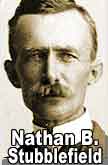
Nathan
B. Stubblefield
•
Click
for more- Ground
Battery
///
  •
102-
Nathan B. Stubblefield, the Man History
Overheard
•
102-
Nathan B. Stubblefield, the Man History
Overheard
By Harvey
Geller
••••
In Life's current Bicentennial issue, radio checks
in, at #86 on the hot "100 Events That Shaped America," 19
buttons behind Bell's telephone. Erroneously, Life lists
Guglielmo Marcon's dots and dashes as the first wireless
broadcast, a fable echoed by the World Almanac and
Encyclopedia Britannica. It's a forgivable mumpsimus, since
the evidence offered on the following pages has not, until
now, appeared in any national publication.
••••
The birth of broadcasting is a bizarre soap opera saga, a
lacrymal legend of mystery, machination, ephemeral
enshrinement, decline, disillusionment and disaster. It's
denouncement dissolves six miles north of Murray, Kentucky,
in a two-room shanty constructed of pine and cornstalks,
where radio's uncelebrated architect is discovered 48 hours
after his death, his records scattered, his equipment
destroyed, his brain partly eaten by rats. Even local radio
fails to mention his demise. He is Nathan Beverly
Stubblefield, the man history over-heard and then
overlooked.
"They all laughed at Christopher Columbus
When he said the world
was round:
They all laughed when
Edison recorded sound . . .
Ha, Ha, Ha -- who's got the
last laugh now?"
--Ira Gershwin, 1937
 When
an inordinately eccentric young farmer suggested that he had
invented a portable wireless telephone that could broadcast
voice and music up over hight buildings and down through
stone walls, most of Calloway County, Kentucky, chuckled.
When he revealed his "crazy box, and odd assortment of
batteries, rods, coils and kegs, they howled. When
an inordinately eccentric young farmer suggested that he had
invented a portable wireless telephone that could broadcast
voice and music up over hight buildings and down through
stone walls, most of Calloway County, Kentucky, chuckled.
When he revealed his "crazy box, and odd assortment of
batteries, rods, coils and kegs, they howled.
•••85
years after, their heirs are writing songs of love,
christening radio stations, consecrating libraries and
constructing memorial monuments in his infinite honor. The
veneration is hardly widespread. 17,000 Murray, Kentucky,
tobacco farmers may agree that Nathan B Stubblefield was the
first man on earth to transmit and receive the human voice
without wires. But most of our world is unacquainted with
his improbable name and even his proponents are unaware of
the precise date of his private discovery. Evidence points
to a period between 1890 and 1892, at least seven years
before Marconi sent the first wireless telegraph message
across the English Channel.
•••
Stubblefield's supporters maintain
that telegraphy is far different from telephony; that they
are, I fact, diverse discoveries. Wireless telephone is
hip-to-shore radio, the walkie-talkie, the citizen band and
portable radio, the mobile phone, the audio arm of
television, rheostats, rectifying tubes, filaments, dials,
microphones, AM and FM radio and every broadcasting booth on
earth--not Marconi's Code signals.
•••Marconi's
name is linked with Stubblefield's by Trumbull White in a
book called The World's Progress, published in 1902. "Of
very recent success are the experiments of Marconi with
wireless telegraphy, an astounding and important advance
over the ordinary system of telegraphy through wires. Now
comes the announcement that an American inventor, unheralded
and modest, has carried out successful experiments of
telephoning and is able to transmit speech for great
distances without wires . . the inventor is Nathan B.
Stubblefield."
• ••
"This Fellow Is Fooling me." ••
"This Fellow Is Fooling me."
•••"Hello,
Rainey," according to Dr. Rainey T. Wells, founder of Murray
State College, was the world's first radio message.
Testifying before an FCC commission in 1947, Rainey
explained that he had personally heard Stubblefield
demonstrate his wireless telephone as early as 1892.
•••"He
had a shack about four feet square near his house from which
he took an ordinary telephone receiver, but entirely without
wires. Handing me these, he asked me to walk some distance
away and listen. I had hardly reached my post, which
happened to be an apple orchard, when I heard 'Hello,
Rainey' come booming out of the receiver. I jumped a foot
and said to myself, 'This fellow is fooling me. He as wires
somewhere.' So I moved to the side some 20 feet but all the
while he kept talking to me. I talked back and he answered
me as plainly as you please. I asked him to patent the thing
but he refused, saying he wanted to continue his research
and perfect it."
•••Dr.
William Mason, Stubblefield's family physician, described a
day during that same year when Stubblefield "handed me a
device in what appeared to be a keg with a handle on it. I
started walking down the lane . . . from it I could
distinctly hear his voice and a harmonica which he was
broadcasting to me several years before Marconi made his
announcement about wireless telegraphy."
••••••
Stubblefield was born in Murray,
Kentucky, 1860 the son of Attorney and Mrs. William
Jefferson Stubblefield (Capt. Billy). In his teens he was
reportedly an omnivorous student and researched everything
available on the new science of electricity. When Alexander
Bel phoned Tom Watson on March 10, 1876, to say "Come here,
Watson; I want you," Stubblefield was already experimenting
with vibrating communication devices. In 1888 (Patent
#378,183) he invented a vibrating telephone. The Murray News
Weekly carried this item: "Charlie Hamlin has his telephone
I fine working order from his store to his home. It is the
Nathan Stubblefield patent and is the best I have ever
talked through."
•••Stubblefield
manufactured and patented batteries which he later described
as "the bedrock of all my scientific research in raidio"
(his spelling).
••••••
"I have been working on this, the
wireless telephone, for 10 or 12 years," he told a St. Louis
Post-Dispatch correspondent in January, 1902. "This solution
is not the result of an inspiration or the work of a minute.
It is the climax of years. The system can be developed until
messages by voice can be sent and heard all over the
country, even to Europe. The world is it limits."
 "Diamonds
as Large a Your Thumb." "Diamonds
as Large a Your Thumb."
•••With
the new industrial and scientific epoch at hand and the
first Roosevelt in the White House, Stubblefield built his
broadcasting station, a tiny workshop on the front porch of
his modest farmhouse. It was barely wide enough to hold the
transmitter and one char. The transmitting mechanism was
concealed in a box four feet hight,tow and a half feet wide,
one and a half feet deep. "In that box," said Stubblefield,
"lies the secret of my success." Five hundred yards away was
the experimental receiving station, a dry-good box fastened
to the foot of a tree stump.
•••The
St. Louis Post-Dispatch reporter noted that Stubblefield's
14-year-old son, Bernard, was left on the porch wile h and
the inventor walked to the stump. The writer picked up a
receiver and heard spasmodic buzzings and then: "Hello. Can
you hear me? Now I will count ten.
One-to-three-four-=five-six-seven-eight-nine-ten. Did you
hear that? Now I will whisper." Later Bernard whistled and
played the mouth organ.
•••"I
heard as clearly as if the speaker were only across a
12-foot room" wrote the newsman.
•••When
the article appeared on January 10, 1902, Stubblefield was
besieged by capitalists, financiers, stock-jugglers,
hucksters and hawkers. Dr. Mason recalled seeing a $40,000
check for a part interest in the invention, as titans of
industry "wearing diamonds as large as your thumb" scuttled
up industry dirt roads to Stubblefield's flinty farm.
•••"You
and I will yet add luster to the Stubblefield name," wrote
Nathan to his cousin, Vernon.
•••He
refused all propositions, including one for half a million
dollars. "It is north twice that," he insisted, entrusting
only his son, Bernard, with the secret of his mysterious
keg. On occasion he repelled over-inquisitive visitors with
a shotgun.
•••Invited
by leading scientist, he traveled with his trunk of mystery
to Washington, D.C., where he demonstrated the
practicability of his contrivance from the steamship
Bartholdy on the Potomac to crowds along the river bank. On
Decoration Day, 1902, he broadcast words and music form the
Belmont Mansion and Fairmont Park in Philadelphia to
hundreds of statesmen, investors and newsmen. He obtained
patents in England, the U.S. and Canada.
••••
In the Canadian patent is a drawing of a "horseless
carriage" with a broadcasting set, presaging the auto radio
by 30 years. But perhaps even more remarkable are notations
that by reversing a switch one could change a broadcasting
station into a receiving apparatus.
••••
Articles appeared in major newspapers throughout the world
acclaiming him as the distinguished inventor of the wireless
telephone and a celebrated scientific genius. At lease one
extravagant reporter suggested that Stubblefield ad crated
"the world's greatest invention."
 Decline
and Fall. Decline
and Fall.
••••
There are three conflicting theories on how this
farmer-inventor sowed the wind of immortality and reaped the
whirlwind of oblivion. His cousin, Vernon, claimed the
invention was stolen
"Will I ever see my trunk again?"
Stubblefield scribbled on the back of an old map after he
returned from Washington.
••••
"All his valuables were in that trunk," said his cousin.
••••
Perry Meloan, newspaper editor of Edmonton, Kentucky, an
ear-witness to the first public demonstration in Murray,
declared that Stubblefield was inveigled into a partnership
in the Wireless Telephone Company of America, located at
Broadway 11, New York. Learning that the firm was not
interested in perfecting his creation but merely in selling
stock unscrupulously, Stubblefield returned home. "Damn
rascals," was his bitter comment to friends, and he advised
them to withdraw their investment in his project. Soon
after, he renounced his wife, nine (5 surviving) children
and all relatives and built his hermitage gut in Almo, six
miles from his family farmhouse. That farmhouse later
mysteriously burned to the ground.
••••
His son, Bernard, joined the Westinghouse Electrical Corp.,
the firm that introduced the commercial radio. Did Bernard
utilize his father's secrets to produce those early
sets?
••••
Wireless lights appeared in the trees and along the fences
guarding Stubblefield's crudely constructed shanty and,
according to neighbors, voices, apparently coming from the
air, were heard by trespassers. "Get your mule out of my
cornfield," Stubblefield's wireless voice was hard to say in
the night.
••••
He curtly refused the aid of friends. "He was never insane,"
they insisted, "only queer."
••••
Robert McDermott found the body of Nathan Stubblefield on
March 30, 1928. "Death due to starvation," was Dr. Mason's
conclusion. In a unmarked grave in Bowman's cemetery, one
and a half miles form Murray, Stubblefield lies alone.
••••
In 1930 a memorial to "the first man to transmit and receive
the human voice without wires" was dedicated at Murray State
Teachers College campus, less than 100 feet from the charred
ruins of the world's first broadcasting station.
••••
In 1962 his tragic life was dramatized in an epicedial folk
opera, The Stubblefield Story, composed by Murray State
professor Paul Shahan and Mrs. Lillian Lowry and performed
in the campus auditorium.
••••
Murray's only radio station, 1 1000-watt outlet, broadcasts
"middle of the road and some rock music as well," according
to owner Fransuelle Cole. Book-ended between Bruce
Springsteen's "Borne to Rune" a a live commercial for
Kroger's grocery, on hears. "You are tune to WNBS, 1340 on
your radio dial in Murray, Kentucky: the birthplace of
radio."
••••
The stations call-letters, not accidentally, are
Stubblefield's initials.
• Click
for Full Story Published
in Warner Bros.
Circular
•
Click
for More tviStory
102-s90- Nathan B. Stubbblefield, the Man History
Overheard
// /
•
Who
are the SMART Inventors of
Radio-WITEL
1890-2017
-
®™©
More
about Nathan Stubblefield
1908
0512 - PATENT GRANTED: Stubblefield's U.S. Patent, Number
887,357, All Purpose Wireless Telephone, Filed April 5,
1907, Granted May 12, 1908. / Click MORE STORY TO GO
DIRECTLY TO U.S. Patent Office - (Patent Expires May 12,
1925) CLICK ANY IMAGE TO VIEW PATENT
•
Click
for More tviStory
102-s90-
#102-NBSHistoryOverheard
•
Click
for More-
Nathan be
Stubblefield
///

///
•
102-
Are Classic SIM cards
out?
New iPhone could deal blow to phone carriers
as classic SIM cards face extinction
••••
Each new iPhone is usually good news
for mobile network operators. In anticipation the latest
Apple Inc. device always comes with upgrades that make it
easier to play games, watch films and download reams of
data. More data means bigger phone bills.
••••However,
the new iPhones might not be so welcome. That's because
there's a possibility that Apple could introduce so-called
electronic sims, or eSIMs, a shift to become inevitable to
the new technology.
••••The
SIMs issue (under investigation by the DOJ) has been rife
since Apple complained to the Justice Department that
Verizon Communications Inc. and AT&T Inc. were colluding
to prevent their introduction.
••••The
classic SIM card is a small chip that is inserted into the
phone manually -- making it more awkward to change the
mobile network provider. You have to go to a shop to get a
new sim or have one delivered physically. The eSIM is
virtual, meaning that just changing your phone's settings
would theoretically allow you to switch carriers.
••••
With certainty this would accelerate
price competition. Whenever it's made easier to jump from
one operator to another, consumers take advantage and seek
better deals. "Churn," the industry term for customer
losses, spikes. That's what ocurred for example, when EU
country brought in rules to cut the time it took to change
network operators to less than 24 hours.
••••European
chipmaker STMicroelectronics NV dropped a heavy hint about
eSIMs saying it expected to deploy its own device in a major
mass-market smartphone by year's end. Whether this is the
case with year's new iPhone will become known soon, but it's
hard to see how the mobile phone operators can resist this
technology for long given its usefulness for consumers.
Apple will certainly argue it that way. It's already used in
some iPads, and STMicro supplies an eSIM for the Apple
Watch.
••••Apple
can't totally dismiss the concerns of the big phone
carriers, since they spend huge sums on marketing the iPhone
and sell it in their stores. But the California giant is
willing to throw its weight around, as shown by the Justice
Department complaint.
••••Although
the eSIM might reduce some logistical costs for carriers
such as Verizon and AT&T, in the longer term it will
become harder to differentiate between network providers.
"From a user perspective, if you ask what service they're
using, they'll say they're an iPhone or Samsung user, not
the operator."
••••It
might make sense for Apple and other phone-makers to keep
the classic SIM port alongside an eSIM in the near term.
That would give operators time to adapt, while making it
harder for them to object.
••••But
the danger for carriers is that the shift to eSIMs moves
them further down the path to becoming little more than
utilities.
••••There
are very few people who don't have a smartphone already,
meaning it's increasingly a battle for market share rather
than new users.
•
Click
More tviStory
102- New iPhone could deal blow to phone carriers as classic
SIM cards face
extinction.
///
•
115-China
will be MIPCOM's 2018 Country of
Honor
The world's entertainment content
market, MIPCOM takes place in Cannes, France, from 15-18
October.
••••
"China has now emerged as a major producer and consumer of
film and television and will play a leading role at MIPCOM,
to present to the world great Chinese stories and work with
colleagues around the globe to usher in a better future,"
said Mrs. Ma Li, Director General of the International
Cooperation Department of the National Radio and Television
Administration, People's Republic of China.
••••
"The Chinese television and entertainment sector has a
special place within the MIPCOM and MIPTV community going
back to 2004 when MIPTV welcomed the largest-ever delegation
of Chinese TV executives at an international television
market. As MIPCOM 2018 Country of Honour, China will be
showcasing its wide range of programme genre destined for
international television channels," commented Laurine
Garaude, Director of Reed MIDEM's Television Division.
•
Click
More tviStory
115-China will be MIPCOM's 2018 Country of
Honor
///
2017
•
102-Snapchat
IPO Pops
"Snap's IPO is a
historic multiplier for our city's tech sector," Los Angeles
Mayor Eric Garcetti said. "It has great potential to power
new dreams, create more opportunity and drive innovation in
what is already one of the world's largest tech hubs."
••••
Snapchat allows users'
messages and photos to disappear seconds after they're
displayed. Most of the 158 millions of people who use
Snapchat each day are younger than 35.
••••
Snap Inc shares closed
at $24.48 in their first day of trading, a 44% jump. Shares
were priced at $17, they opened up on the New York stock
exchange at 24.00, the price at which new shareholders could
opt to sell and prospective shareholders cold choose to
buy.
•
Employees at Snap are
celebrating
Snap Inc.'s employees helped turn the Venice start-up
into a $37-billion public company. Now, the question is,
will they do the same on their own.
••••
The region's tech
community is hoping the wealth bestowed to hundreds of Snap
Inc. employees by the third-largest initial public offering
in California history spurs them to become entrepreneurs and
investors in their own right. Snap employees already are
having conversations with venture capitalists to help line
up possible future funding.
••••
Workers peeling off
after an IPO or an acquisition is a common phenomenon. Some
people prefer returning to a smallere operation where
bureaucracy doesn't stifle their bold ideas. Others view
their new fortune both as a calling card that boosts up
their reputation and a safety net that hedges against the
financial risks of entrepreneurship.
••••
Employees at Snap are
now sitting on billions of dollars' worth of shares. But
more than half of the company's employees joined in the last
18 months, and most of the stock in their pay package
doesn't arrive until their third and fourth years of
employment. That's a very powerful incentive to stick
around. In addition, Snap went public at an early stage, and
its co-founders Evan Spiegel and Bobby Murphy, hold an
outsized vision for the company's potential. Those factors
could lead people to believe the fortune waiting ahead of
them at Snap is hard to beat.
••••
Also, there are other
reasons to stay longer. Snap's employees are valuable
because they've seen what it takes to take a company public.
Learning the basics of operating in a public company will
make them even more valuable.
••••
For many there is going
to be desire to stay with that mothership for a little
while, but over time, maybe three years out, a lot more will
go out on their own."
••••
Leaving however comes
with risks, though. Companies generally don't welcome back
people who want to return down the road. And most start-ups
don't turn into billion-dollar businesses.
•
Click
More tviStory
102-s90- Snaphat IPO
///
•
102-
FCC's latest spectrum auction nets $7 billion for US
Treasury
The second major forward phase of
the broadcast incentive spectrum auction by US telecoms and
broadcast regulator the FCC has come to a close.
••••The
FCC is carrying out an incentive auction of unused analogue
TV spectrum, left over from the digital TV transition. The
hope is to free up more spectrum for 4G/5G and advanced
wireless services, like mobile video.
••••The
two-sided auction for the spectrum was meant to pay
broadcasters a fair value for their assets before selling
them to the highest-bidding mobile carriers.
••••After
months of action, bids from spectrum hunters have totalled
$19.63 billion for 70 MHz of spectrum sold by broadcasters
in an earlier, reverse auction phase.
••••Now
follows a smaller assignment phase that could bring some
extra funds as bidders aim for more specific frequencies in
markets. But with the auction largely complete, the US
Treasury will get about $7 billion for deficit
reduction.
••••Once
the assignment phase ends (in two to three weeks), the FCC
will reveal complete bid winners from the auction.
Broadcasters from the reverse auction are free to talk about
the winnings publicly, while forward participants must
remain silent for now.
••••Those
broadcasters that chose not to participate will have their
spectrum 'repacked' into other bands to protect their
signals from neighbouring interference and ensure
uninterrupted TV service. The FCC has proposed setting aside
up to two UHF channels in every US TV market for Wi-Fi and
other unlicensed wireless services as well, but this
so-called 'vacant channel' effort has been
controversial, as it takes valuable real estate away
from low-power TV stations (LPTVs) looking to find new homes
after the agency's repacking, broadcasters have
argued.
•
Click
More tviStory
102-s90- FCC's
latest spectrum auction nets $7 billion for US
Treasury
///
2016
•
Who Invented the Wireless
Telephone?
•
102-WIRELESS
TELEPHONE Industrial School of Arts & Sciences -
1902
•
Excerpts
from: Smart Daaf Boys, Stubblefield's 1993
"All-in-One Radio/Television & Desk Top Almanac
Encyclopedia- Dictionary.
(456 Pages ) • ISBN No.
10883644-04-6Library of Congress Catalog Number 93-060451
Volume IV, A Source Book for Comminications Executives
& Researchers Dictionary.
(456 Pages ) • ISBN No.
10883644-04-6Library of Congress Catalog Number 93-060451
Volume IV, A Source Book for Comminications Executives
& Researchers
Copyright 1993: By Telvision International Publishing (TVI
Publishing)
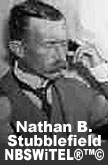 102WIRELESS
TELEPHONE Industrial School of Arts & Sciences -
1902 102WIRELESS
TELEPHONE Industrial School of Arts & Sciences -
1902
- In January
1902, Stubblefield agreed to participate in the commercial
exploitation of his device by Fennell's Philadelphia Group
that purportedly included Westinghouse. Incorporation papers
for the Wireless Telephone Company of America were filed in
Prescott, Arizona, on May 22, 1902. Stubblefield was a
director, but held no office. The Washington and
Philadelphia demonstrations maintained the momentum needed
to sell stock in the new company. A four page prospectus,
extolling the investment opportunity in Wireless Telephone
Company of America compared the Stubblefield device with
Marconi's wireless telegraphy system by stating that both
systems utilized "... for
transmission what are termed Hertzian electrical wave
currents ..." The technical details were not disclosed since
the prospectus was designed to sell stock, and perhaps
deliberately avoided specific evidence on the points of
comparison or contrast. The use of steel rods thrust into
the ground, the large circular coils and the copper antenna
wires attached to the masts on the steamer Bartholdi and on
rooftops indicate that Stubblefield's 1892, 1893 and 1902
systems were based upon Stubblefield's earth grounded
induction-antenna principle, in which we now call, AM radio.
Stubblefield insisted that a more "powerful" apparatus would
"transmit" unlimited distances. The U.S. Navies ELF project
in Clam Flats, Wisconsin is based on Stubblefield's basic
induction-antenna device.
•
Wireless
Telephone: 1898: Patent For Electrolyte Battery and
Detector for Radio Signal (wireless telephone) Issued
600,457.
{19/Gx}
•
wireless - (1) A
British term for radio.
(2) Used in the United States, in the sense
of (#1) above, when the word "radio" might be misinterpreted
(as an example -- a "wireless record player"). {73/RS}
•
Section
19.
Wireless
Telephony - The
early radiotelephones were powered by wet-cell,
non-rechargeable batteries. The telephone at first also used
electricity. Today's radio and television stations receive
their current from power lines fed by huge dynamos, some
powered by atomic fission. The increasing sophistication of
power sources, (solar, cell) parallels the continued
movement toward greater sophistication in electrical
communication methods. {01/Gi}
•
Wireless Telephony
and Stubblefield
-
Nathan B. Stubblefield's "Wireless Telephony" - ("Radio"):
In addition to the following listings under "Wireless
Telephony," as well as those listed above under "Wireless
Signals," also see the section in this book, under:
"Stubblefield, Nathan B" with the various terms,
definitions, patents issued, demonstrations, historical
facts, etc., on Nathan B. Stubblefield (The "Inventor" Of
The "Wireless Telephony" -- The "Radio").
••• •
Please See Section 15. Stubblefield and "Wireless Telephony"
("Radio").
••• •
Also See Radio: Publications "Broadcast&endash;Industry
Trade Resource/Reference Books" with a section on Nathan B.
Stubblefield.
••• •
Also See Radio: Publications "Hard&endash;Cover Books" with
a section on Nathan B. Stubblefield.
••• •
Also See Radio: Publications "Magazines" with a section on
Nathan B. Stubblefield.
{03/Di}
•
WIRELESS TELEPHONY
and TELEGRAPH
••• (1)
RADIO
FREQUENCY
(ra-di--o-fre-quen-cy),
n. (a). the frequency
of the transmitting waves of a given radio message or
broadcast. (b). a frequency within the range of radio
transmission, i.e. from about 15,000 MC to 10 MC
(MegaCycles) per second. [Note: A MegaCycle means, "one
million cycles" -- so 15,000 MC is equal to 15,000 x
1,000,000, which is 15,000,000,000 cycles per second (15
billion cycles per second); and 10 MC is equal to 10 x
1,000,000, which is 10,000,000 cycles per second (10 million
cycles per second).]
••• (2)
RADIO
(ra-di-o),
n. (a). wireless telegraphy: sparks or dot&endash;dashes
broadcasted by radio. (b). telephony: speeches or music
broadcasted by radio. (c). an apparatus for receiving radio
broadcasts. (d). a message transmitted by radio.
••• (3)
BROADCAST
(broad-cast),
v. To send (messages,
speeches, music, sounds) by radio. {19/Gx}
•
Wireless Telephony:
1860: Murray, Kentucky: Nathan B. Stubblefield
- Nathan B.
Stubblefield, "The Inventor Of Radio" (Wireless Telephony)
was born in Murray, Kentucky in 1860. Stubblefield died in
Murray in 1928, where he is buried. {19/Gx}
•
Wireless
Telephony: 1885: First World's Private Wireless
(Voice) Transmission-
Demonstration. In
1885, Nathan B. Stubblefield, "The Inventor of Wireless
Telephony" held his First Demonstration, [which was the
World's First Private Demonstration of wireless (voice)
transmission on land]. Stubblefield, from Murray,
Kentucky: Patented his invention in 1898 and also in 1908.
{19/Gx}
•
Wireless
Telephony: 1885:
Stubblefield
demonstration to his friend, Duncan Holt, the transmission
of voice without wires. Holt stated, "One Sunday that year
[1885] Stubblefield invited Holt and his wife out to
his home, where the west boundary of Murray State College
now is. That afternoon he said to Holt, "Duncan, I've done
it. I've been able to talk without wires -- all of 200 yards
-- and it'll work everywhere!" Stubblefield had a little
"experimental station" he called it, 200 yards away from the
house, and he said he could talk from there and it could be
heard at the house, or vise&endash;versa -- and without
wires! At that time, Holt said, "the Scientific American had
never mentioned the possi bility in suggestion or otherwise
that speech or intelligent communication could be
transmitted with out wires. Stubblefield was the first to
entertain the idea. "{19/Gx}
•
Wireless
Telephony: 1892: First World's Public Radio
Demonstration
- In 1892, the
World's First Public Radio Demonstration -- [World's
First Public Demonstration of wireless (voice) transmission
on land] was held in Murray, Kentucky.
••• In
the winter of 1892, Nathan B. Stubblefield made a tremendous
ad vance in his "wireless telephone" demonstrations, which
would make wireless practi cal over distances far greater
than those from his experimental home to the garden, dis
tances which would first encompass the earth and then reach
far out into the universe and to uni verses beyond. It was
Stubblefield's great invention of the "wireless telephone"
that helped him discover the basic principals and laws of
Amplitude Modulation, (AM Radio).
••• To
advance his low&endash;frequency induction system to a space
system, he built an aerial -- an antenna which he connected
to one side of the carbon mouth piece of a telephone: (to
send a spark wave; Hertz had merely used a horizontal rod
ending in a plate.) The aerial was copper wire wrapped
around a cylinder, or in some cases made into a loop, that
was attached to the top of a pole (later he used longer
aerials strung along the top of his family home). He con
nected the other side of the carbon coil located inside of
the mouthpiece to his electrolyte water batteries and
crystal, stacked and positioned inside his secret "black
box." Ground wires from the "black box," then lead to the
metal stakes driven into the earth. The re ceiver also got
an aerial and ground. {19/Gx}
• WIRELESS
TELEPHONY: 1892: Nathan B. Stubblefield
-
In January, 1892,
Nathan B. Stubblefield demonstrated this "WIRELESS
TELEPHONY" system in Murray, Kentucky before several hundred
on lookers. A total of $758.00 was borrowed from friends and
relative to perform this demonstration. During the same
year, Stubblefield, again privately, demonstrated to Rainey
T. Wells the ability of his apparatus to send and receive
the human voice by wireless. After he had set up his props,
the inventor talked into one box in rather low tones, and
his words "Can you hear me?" Came out the other box "quite
distinctly and clearly" as attested to by witnesses.
••• Dr.
W. H. Mason, a Murray sur geon who claimed to be a per sonal
friend and family physician for Nathan B. Stubblefield,
declared that in the same year he wit nessed a private
demonstration of the wireless tele phone. Dr. Mason recalled
that on one occa sion, Nathan B. Stubblefield handed him a
device "housed in what appeared to be a keg with a handle on
it." The doctor then followed instructions to walk down the
lane carrying the keg. He testified that from it he could
hear distinctly "Nathan's voice and a French harp
(harmonica)" which Nathan was sending. {19/Gx}
•
Wireless
Telephony: 1895: Dit Dahs "dots & dashes"-
Guglielmo Marconi
- In the spring of
1895, what Nathan B.
Stubblefield did with wireless voice transmission in 1885,
Guglielmo Marconi did with dots and dashes. He discovered
that he could send signals over distances far greater than
those from his villa to the garden -- dis tances which would
travel more than a mile It was Marconi's great basic in
vention of signal induction -- if, indeed, it was his. Like
Stubblefield, he built an aerial -- an antenna which he
connected to one side of the spark gap. (Hertz had merely
used a horizontal rod ending in a plate.) The aerial was a
metal cylinder atop a pole. He con nected the other side of
the spark gap to a ground -- at first, a copper plate ly ing
in the ground. The re ceiver also got an aerial and ground.
{19/Gx}
•
Wireless Telephony:
1998: electrolyte water battery "Stubblefield, Nathan
B" - 1898
The patent on the
Stubblefield electrolyte water battery, number 600,457, was
the device that provided the energy to produce the continual
subcarrier hum during Stubblefield's voice transmission when
it was connected to his "black box" that contained the
electrolytic crystals that acted as detectors and
modulators. The portable receiver contained the necessary
detector to receive the voice broadcast. Stubblefield
advertised that by slightly modifying the telephone coil,
one could transmit through the ground for many miles -- the
battery acting as a relay. {19/Gx}
•
Wireless
Telephony: 1898: ground cell (Stubblefield, Nathan
B.) -
1898:
Stubblefield's
Electrolyte Water
Battery. The patent on the Stubblefield bat tery, number
600,457, declares in the specification forming part of the
letters of patent that the electrical battery has for its
object: to provide a novel and practical battery for
generating electrical currents of suf ficient forms for
practical uses, and also pro viding means for generating not
only a constant pri mary current but also an induced
momentary sec ondary current.
••• This
electrical battery is the "ground cell" or "earth cell"
frequently referred to by Stubblefield in many of his
writings and interviews. Stubblefield so named the de vice
because when he first began his experimentation with it, he
would place the device that he had constructed in the moist
earth of his farm. Then, when electrical cur rents began to
flow from the device, he assumed that the engine he had
constructed was tapping the "natural elec tricity" of the
earth. Note, for example, how he describes the action of his
electrical battery: This cell de rived sufficient electrical
energy from the ground in the vicinity of the spot where it
was buried to run a small motor continuously for two months
and six days without any attention whatever. Indeed, the
electrical cur rent was powerful enough to run a clock and
several small pieces of machinery and to ring a large gong.
By adding a modified carbon microphone to the batteries, it
creation wireless voice transmission. {19/Gx}
•
CLICK FOR MORE USPTO 102 S90
STORY
http://smart90.com/nbs100/NBStubblefieldPat02Auto.htm
///
•
102-Sean
Parker takes on Hollwood with new home video service
-
• Screening
Room
Former co-founder of Napsters is
pitching Hollywood on an unorthodox home-video service
called Screening Room that would give users access to films
the day that they're released in theaters for $50 each. If
Parker succeeds, it could open a vast new revenue stream for
him and change how entertainment is consumed in the
home.
••••The
system is scheduled to be shown to industry professionals in
private meetings held in Las Vegas during the annual
CinemaCon convention next week.
••••The
Screening Room service would offer 48-hour rentals of films
via a set-top box that would cost about $150. Revenue would
be split among Screening Room, studios and exhibitors. Also,
each rental would come with a pair of tickets to see the
film in movie theaters.
••••Netflix
and other popular streaming video platforms have allowed
consumers to watch on-demand content from the comfort of
their increasingly high-tech living rooms. Trends in media
consumption suggest that eventually people will be able to
watch movies at home starting the day they are released in
cinemas.
••••But
there is skepticism that Parker is the person to crack the
code. Doubters have cited Napster as evidence that Parker
may not be the right person to take on Hollywood.
••••Screening
Room would not be the first to rent movies to consumers at
home on the same day that they are released in cinemas.
Prima Cinema Inc. offers a service that allows users who
shell out $35,000 for an in-home device the ability to
screen first-run films for $500 a pop. Prima, caters to a
high-end crowd.
••••"Our
goal was never to try to disrupt a business," Prima Chief
Executive Shawn Yeager said. "At $50, it is hard to imagine
how Screening Room doesn't disrupt."
• About Parker
••••Parker
grew up in Herndon, Va., not far from Washington, D.C. He
was turned on to programming at an early age when his
oceanographer father gave him a computer and taught him how
to use it. By his teenage years, Parker was hacking into the
computer systems of corporations and governments. That led
to his arrest at the age of 16 by the FBI. He was given
community service for his offenses.
••••
In 1999, Parker -- who did not go to college -- moved to
California to join up with Shawn Fanning, whom he had met
online and who was then creating Napster.
••••Together,
Fanning and Parker, then just 18 and 19, roiled the music
industry by releasing Napster in 1999. Tens of millions of
people were soon using the service to download MP3 music
files, but a wave of lawsuits shut it down in July 2001.
••••In
addition to Napster, Parker backed Facebook and Spotify
early on. His wealth soared when Facebook went public in
2012.
••••Parker
joined Facebook in 2004, and as the company's first
president, he has been credited with helping transform it
from a fledgling website started in Mark Zuckerberg's
Harvard dorm room into a serious business. He has been
described as a mentor to Zuckerberg and an advocate for the
Menlo Park, Calif., company and its founder during its rocky
early days.
••••But
Parker was long gone from Facebook by the time of its
initial public offering of stock: He left his post in 2005
after the cocaine-related arrest (he was not formally
charged with a crime).
••••In
2013, Parker married singer-songwriter Alexandra Lenas in a
fairy-tale themed gathering that required construction of
"artificially created 'ruins' of cottage and castle walls,"
at a coastal redwood forest in Big Sur.
///
• Click
for more tviStory
106- Home Video Service Screening Room

|
|
|


