^
^
^
^
^
^
^
^
^
2^
^
^
^
^
^
^
^
2^
^
11
^
^
^
^
^
^
^
^
^
^
^
2^
^
^
11
^
^
^
^
^
^
^
^
^
^
^
2^
^
^
^
^
^
^
^
^
^
^
^
2^
^
11
^
^
^
^
^
^
^
^
^
^
^
2^
^
^
^
^
^
^
^
^
^
^
^
2^
^
^
^
|
|


Gaza has been under intense, daily, and
ongoing military attack since Octbober 7, 2023. following a
Hamas led attack on Israel. As of early 2026 this has
resulted in at least 72,000 deaths of Palestinians including
20,000 children, and severe devastation.
While the current daily assaults began in
2023, the region has been subject to a strict Israel
air,sea, and land blockade since 2007.
Latest poll show over 60% of Americans
disapprove of Israeli's military action.
Foreign
Wars rejected by a high number of
Americans
The
Costs of an Unchecked Alliance: Voices from the Communities
Bearing the Burden - By Mark
Anderson
Across America's poor neighborhoods --
Black, Latino, Indigenous, and white working-class
communities&emdash;the U.S. alliance with Israel is not an
abstract foreign-policy debate. It is a lived reality that
many believe diverts resources, risks lives, and deepens
domestic injustice. Below are the fundamental perspectives
and grievances expressed by people most likely to be harmed
by U.S. involvement in wars abroad.

• Economic strain and misplaced
priorities
Economic strain and misplaced
priorities
• Money that could help here:
Residents watching billions in military aid flow overseas
say those funds could pay for housing repairs, school
funding, Medicaid expansion, food assistance, and jobs
programs in their neighborhoods. For families living
paycheck to paycheck, the choice to prioritize foreign
military assistance feels like a direct
abandonment.
• Services sacrificed: Community
organizers note that austerity at the municipal and federal
level&emdash;cuts to public transit, mental-health clinics,
and youth services&emdash;often coincides with robust
foreign assistance packages, reinforcing the view that
government priorities are misaligned with local
needs.
Risk of blowback and everyday
safety
• Fear of retaliation and hate
crimes: People in marginalized
communities&emdash;particularly Muslims, Arab Americans, and
visibly Jewish neighbors&emdash;report heightened anxiety
about targeted harassment and violence following U.S.
involvement in conflicts perceived as one-sided. Poor
neighborhoods, with fewer resources for protection or legal
help, feel especially vulnerable.
• Policing and militarization: Many
residents see a link between foreign military engagement and
the spread of militarized tactics at
home&emdash;surveillance tech, heavy-handed policing, and
paramilitary equipment&emdash;all disproportionately
deployed in poor communities of color.
Democratic voice and political
alienation
• Powerlessness: Poor and
working-class Americans often feel that special-interest
funding, lobbying, and elite networks drown out their
voices. When foreign-policy stances persist regardless of
mass protest, the result is political
alienation&emdash;voters convinced that neither party will
change a course they see as harmful.
• Distrust of institutions: The
sense that money and influence distort policy feeds broader
distrust in Congress, the media, and the justice
system&emdash;institutions that already fail many low-income
communities.
Humanitarian empathy and moral
outrage
• Seeing themselves in the victims:
Families who have experienced displacement, police violence,
or child casualties resonate deeply with imagery of civilian
suffering abroad. For many, the moral clarity is simple: if
we condemn violence here, why tolerate it elsewhere with our
tax dollars?
• Calls for consistent standards:
Activists from marginalized communities insist that U.S.
support must be conditioned on adherence to international
law and protection of civilians&emdash;not blind loyalty
that sacrifices human lives.
Racial and historical context
• Comparative injustice: African
American communities often draw parallels between historical
U.S. policies&emdash;slave-era dispossession, systemic
segregation, and forced displacement&emdash;and what they
view as similar patterns in Palestinian dispossession. This
historical lens fuels solidarity and demands for consistent
human-rights advocacy.
• Intersectional impacts: Poor
Latinos, Native Americans, and immigrant families highlight
overlapping vulnerabilities: immigration enforcement tied to
foreign-policy positions, cuts to social programs, and
cultural stereotyping that increases scapegoating during
conflicts.
Media access and information
trust
• Looking elsewhere for truth:
Frustration with mainstream coverage leads many to trust
independent and international outlets. In poor communities
where distrust of institutions is high, alternative media
and grassroots reports shape perceptions more than
establishment narratives.
• Misinformation vulnerability:
Limited access to reliable journalism and civic education
makes communities vulnerable to propaganda from varied
sources&emdash;heightening confusion and anger.
Demands from affected
communities
• Redirect resources: Prioritize
domestic needs&emdash;housing, healthcare, education, and
jobs&emdash;before expanding costly foreign
commitments.
• Condition aid on human-rights
compliance: Tie military and economic assistance to clear,
enforceable human-rights benchmarks and
transparency.
• Strengthen oversight and curb
undue influence: Enforce campaign finance reform, lobby
transparency, and stronger congressional oversight so poor
communities' priorities are not drowned out by well-funded
interests.
• Protect communities at home:
Invest in anti-hate protections, community safety programs,
and de-militarization of local policing to shield vulnerable
neighborhoods from spillover harms.
\Conclusion: For many poor
Americans&emdash;Black, Latino, Indigenous, and white
working-class&emdash;the U.S. relationship with Israel is
not merely geopolitical; it is a domestic justice issue.
They see squandered resources, heightened risks, and a
political system skewed toward wealthy influence. Addressing
these concerns requires shifting the debate from abstract
strategy to concrete consequences: reallocating priorities
to serve the most vulnerable, enforcing accountability
abroad, and restoring democratic power at home so those who
bear the costs finally have a real say.
•
Click
for more tviStory
106- The
Costs of an Unchecked Alliance -
///
9/11
Through the Media Lens: 25 Years
Later
In Collaboration with the National
September 11 Memorial &
Museum
Thursday, September 10, 2026 |
6:30 pm
The Paley Museum, 25 West 52
Street, NYC
NEW YORK, - On September 11, 2026, the
nation will mark the 25th anniversary of the attacks that
claimed 2,977 lives and reshaped American life. As we
approach this milestone, The Paley Museum, in collaboration
with the National September 11 Memorial & Museum, brings
together a distinguished panel of journalists, historians,
and photographers who covered the events firsthand, as well
as those who later documented, analyzed, and reflected on
that tragic day. The conversation will explore their
personal experiences and perspectives, how news was reported
across media platforms in 2001, how reporting has evolved in
the decades since, and why preserving these firsthand
accounts and reflections remains essential to informing
future generations.
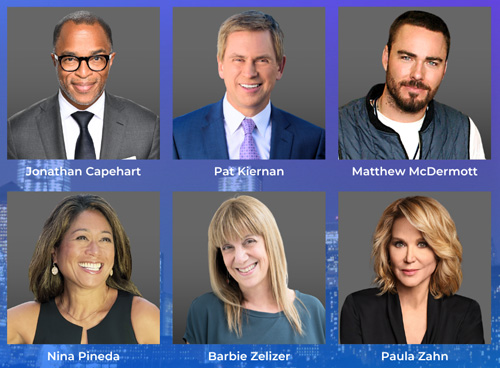
In
Person:
Jonathan Capehart, Cohost, The
Weekend on MS NOW; Political Analyst, PBS News Hour;
Pulitzer Prize-winning Journalist; New York Times
Best-selling Author
Pat Kiernan, Anchor, Mornings on 1,
Spectrum News
NY1
Matthew McDermott,
Photojournalist
Nina Pineda, 7 On Your Side,
Consumer Reporter,
WABC-TV
Barbie Zelizer, Professor of
Communication, The University of Pennsylvania's Annenberg
School for Communication; Editor, Journalism After September
11
Moderator: Paula Zahn, Host &
Executive Producer, Investigation Discovery's Newsmagazine,
On the Case with Paula Zahn
Ticket
Info
Paley Member Presale for Partner
level and above now
open.
Public sale begins Friday, August
28 at noon ET.
•
Click
for More tviStory-
9/11 Through the Media Lens: 25 Years
Later
///
•
106-SAG-AFTRA,
OpenAI Ensure Voice Likeness Protection in Sora
2
Association of Talent
Agents, United Talent Agency, Creative Artists Agency also
Join to Protect Performers
LOS ANGELES, SAN FRANCISCO, LONDON, (Oct.
20, 2025) - SAG-AFTRA, OpenAI, Bryan Cranston, United Talent
Agency, Creative Artists Agency, and Association of
Talent Agents jointly released the following statement
regarding the productive collaboration on ensuring voice and
likeness protections in Sora 2.
Actor Bryan Cranston's voice and likeness
were able to be generated in some outputs without consent or
compensation when OpenAI's Sora 2 was initially launched in
an invite-only release two weeks ago. While from the start
it was OpenAI's policy to require opt-in for the use of
voice and likeness, OpenAI expressed regret for these
unintentional generations. OpenAI has strengthened
guardrails around replication of voice and likeness when
individuals do not opt-in.
Cranston, who brought the issue to the
attention of SAG-AFTRA, said, "I was deeply concerned not
just for myself, but for all performers whose work and
identity can be misused in this way. I am grateful to OpenAI
for its policy and for improving its guardrails, and hope
that they and all of the companies involved in this work,
respect our personal and professional right to manage
replication of our voice and likeness."
OpenAI has an opt-in policy for uses of
an individual's voice or likeness in Sora 2. All artists,
performers, and individuals will have the right to determine
how and whether they can be simulated. This policy reflects
the company's commitment to artist rights, transparency, and
the ethical deployment of generative technology. It has also
committed to responding expeditiously to any complaints it
may receive.
The NO FAKES Act
This new framework aligns with the
principles embodied in the NO FAKES Act, pending federal
legislation designed to protect performers and the public
from unauthorized digital replication. OpenAI, SAG-AFTRA,
Bryan Cranston and his representatives at United Talent
Agency, the Association of Talent Agents and Creative
Artists Agency share a strong, unified position in favor of
the NO FAKES Act and endorse its goal of establishing a
national standard that ensures performers' voices and
likenesses cannot be used without permission. Together, we
believe consent and compensation are the foundation of a
sustainable and ethical creative ecosystem for entertainment
and tech.
SAG-AFTRA President Sean Astin said,
"Bryan Cranston is one of countless performers whose voice
and likeness are in danger of massive misappropriation by
replication technology. Bryan did the right thing by
communicating with his union and his professional
representatives to have the matter addressed. This
particular case has a positive resolution. I'm glad that
OpenAI has committed to using an opt-in protocol, where all
artists have the ability to choose whether they wish to
participate in the exploitation of their voice and likeness
using A.I. This policy must be durable and I thank all of
the stakeholders, including OpenAI for working together to
have the appropriate protections enshrined in law. Simply
put, opt-in protocols are the only way to do business and
the NO FAKES Act will make us safer."
"OpenAI is deeply committed to protecting
performers from the misappropriation of their voice and
likeness. We were an early supporter of the NO FAKES Act
when it was introduced last year, and will always stand
behind the rights of performers," said Sam Altman, CEO,
OpenAI.
///
Memorial
Day
TVI's Gary Sunkin poses
with Flag at Forest Lawn, Los Angeles
What we now refer to
as Memorial Day began as Decoration Day just after the Civil
War in 1868. It was established as a day to remember the war
dead by decorating their graves with flowers. The North and
The South originally observed Decoration Day on different
days until the mid-20th century when the last Monday of the
month was chosen to honor all Americans who died while
serving in the military.
On Memorial
Day, the flag of the United States is raised briskly to the
top of the staff and then solemnly lowered to the half-staff
position, where it remains only until noon. It is then
raised to full-staff for the remainder of the
day.
In 2000, Congress
passed the National Moment of Remembrance Act asking people
to stop and remember at 3:00 pm.

Celebrate
unofficial beginning of summer with Memorial Day but always
remember the sacrifices of our service members in the U.S.
Army, Navy, and Marine
Corps.
(TVI
Magazine)
• Fellow
Americans, It's Gary Sinise here
 You
may know me from my roles in movies like Apollo
13 and The Green Mile or the CBS television
series CSI NY -- but it was in 1994 and playing the role of
Lt. Dan in Forrest Gump, that my life changed and
inspired my enduring connection to our defenders, veterans,
and first responders. You
may know me from my roles in movies like Apollo
13 and The Green Mile or the CBS television
series CSI NY -- but it was in 1994 and playing the role of
Lt. Dan in Forrest Gump, that my life changed and
inspired my enduring connection to our defenders, veterans,
and first responders.
.....
I've served as an Honorary Grand
Marshal for the National Memorial Day Parade in Washington,
D.C. nearly every year since American Veterans Center
revived it in
2005.
.....
Now, I'm grateful to again serve as
an Honorary Grand Marshal on the 20th anniversary of this
important
event.
.....
This year will be a remembrance like
no other, as we commemorate the 80th anniversary of victory
in World War II and the 250th birthdays of the U.S. Army,
Navy, and Marine
Corps.
.
.
....
Friend, the National Memorial Day Parade is ENTIRELY
FUNDED by private contributions, including from generous
Americans like you. Will you help chip in today to help
support the Parade with a gift of $25, $50, $75, $150, or
more?
Support
the National Memorial Day Parade
...
The National Memorial Day Parade
costs a fraction of other major public events to put on each
year. In fact, the entire parade costs about as much as just
THREE balloons in the Macy's Thanksgiving Day Parade or TWO
floats in the Rose Bowl Parade!
.....
That means that every dollar that's
contributed by a generous American like you makes a
difference for this important
event.
.....
But I want to reiterate that American
Veterans Center does not take ANY federal funding for this
event. It is funded entirely by private citizens like you
who want to honor those who have sacrificed so much for our
country.
.....
Your support of the American Veterans
Center not only helps the Parade, but also supports great
programs like:
• Record hundreds of oral histories
of veterans from World War II to Today before we lose these
stories forever.
• Hold our National Youth Summit
which allows young students a chance to hear first-hand from
veterans from WWII, Korea, and Vietnam.
• Produce veteran focused T.V.
documentaries and specials that remind Americans the price
of our freedom.
Please
join me in support of the National Memorial Day Parade with
a gift of $25, $50, $75, $150, $250, $500, or more right
now.
.....
If you've been looking for an
opportunity to give back to those who have given so much for
our freedom, this is one of the best possible ways you could
do it.
.....
And for a special group of veterans,
this might be one of the last chances we
get.
.....
You see, with each year that goes by,
we lose more and more of our World War II veterans, and for
the few we have remaining, traveling to Washington, D.C.,
for the parade is
difficult.
.....
WWII veterans were a key part of the
first parade when it was revived in 2005, as they have been
every year since for the last 20
years.
.....
But this may be the last year we have
the opportunity to have these brave men and women with us
for the
parade.
.....
That's why we are making a concerted
effort to ensure these veterans are at this year's National
Memorial Day Parade to honor them one last
time.
.....
So this year, as we mark the 80th
anniversary of victory in Europe and Japan to end World War
II -- and the 250th anniversaries of the Army, Navy, and
Marine Corps -- I encourage you to help us honor these brave
veterans while we still have them with us.
Support
the National Memorial Day Parade
.....
And no matter how much you can give
to this important cause, I want to ask something additional
of you.
.....
On Memorial Day -- not just this
momentous year of military milestones, but every year -
please join me in honoring those who made the ultimate
sacrifice for our
freedoms.
.....
Come to the National Memorial Day
Parade in Washington, D.C. Visit a local veterans' cemetery.
Send a note to a family of the fallen. Or simply take a
quiet moment to think about the men and women who gave their
lives to defend OUR
country.
.....
I believe that while we can never do
enough to express our gratitude to our defenders, veterans,
and first responders, we can always do a little
more.
Friend,
thank you for your support of America's heroes, and please
-- if you're able, make a gift to fund the National Memorial
Day Parade right now during its 20th
anniversary.
.....
Sincerely,
Gary
Sinise
Honorary Grand
Marshal
National Memorial Day
Parade
Memorial
Day Concert
WASHINGTON, DC --
PBS will broadcast the National Memorial Day
Concert live from Washington, D.C. on Sunday, May 25, 2025,
from 8:00 to 9:30 p.m. E.T. as well as to our troops serving
around the world on American Forces Network on the West Lawn
of the US Capitol. This will be the 35th year the annual
all-star event honors the men and women who served in the
U.S. armed forces, as well as their families and those who
sacrificed their lives for their country.
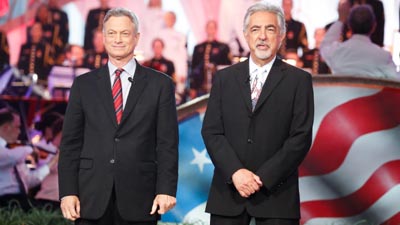
Emmy Award-winner Gary Sinis and Tony
Award-winner Joe Mantegna, who have dedicated themselves to
supporting the troops and veterans' causes co-hosted the
Memorial Day Concert for many years. Esai Morales is
stepping in this year for Mantegna who has a minor inner ear
issue which is preventing him from flying. Mantegna will be
back co-hosting next
year.
•
Click
for More
tviStory
106- Memorial Day Parade with Gary
Sinise
///
•
106-
SAG-AFTRA Leaders Take to Capitol Hill for SAG-AFTRA NO
FAKES Act Reintroduction
LOS ANGELES (Apr. 9, 2025) -- Today, a press conference was
held celebrating the SAG-AFTRA-supported, bi-partisan
Nurture Originals, Foster Art, and Keep Entertainment Safe
(NO FAKES) Act as it was reintroduced in the Senate. If
passed, the bill - sponsored by Sens. Marsha Blackburn,
Chris Coons, Amy Klobuchar and Thom
Tillis
-
would establish a federal
right in voice and likeness to protect against unauthorized
use of digital replicas in audiovisual works and sound
recordings.
••••
SAG-AFTRA President Fran Drescher
said, "The NO FAKES Act isn't just about protecting actors,
recording artists and broadcasters. Deepfakes can ruin all
lives. It doesn't matter if you're a public figure or a high
school student being exploited by internet creeps. It's time
to give humans the power to say NO, not my face, not my
voice! Thank you Senators Blackburn, Coons, Klobuchar and
Tillis for defending the rights of humans in the age of
digital clones!"
••••
"In the age of digital clones,
deepfakes can be devastating," said Duncan Crabtree-Ireland,
National Executive Director and Chief Negotiator, SAG-AFTRA.
"For the creative community, this bill is especially
meaningful. SAG-AFTRA members and those who rely on their
face and voice for their livelihood will be able to demand
platforms remove illegal voice and image clones. Creatives
will also be able to seek damages from those who
intentionally cause harm. Thank you Senators Blackburn,
Coons, Klobuchar, and Tillis for reintroducing the NO FAKES
Act. As innovation continues to rapidly evolve, it's time
for commonsense legislation that defends individual
rights."
••••
The NO FAKES Act would preserve
existing protections at the state level, such as Tennessee's
landmark SAG-AFTRA-supported ELVIS Act and California's
SAG-AFTRA-sponsored AB2602, while providing one strong,
consent-based framework for digital replica uses in
expressive works nationwide.
///
•
106- Gov.
Newsom Signs Union-Championed A.I. Bills at SAG-AFTRA Plaza
Two
bills mandate new protections against the dangers of
artificial intelligence
technology.
LOS ANGELES (Sept. 17, 2024) --
California Gov. Gavin Newsom visited SAG-AFTRA headquarters
in Los Angeles, where he signed into law critical
legislation that will give individuals more agency over the
use of their voice and likeness. At a meeting convened at
SAG-AFTRA Plaza with SAG-AFTRA President Fran Drescher,
Secretary-Treasurer Joely Fisher and National Executive
Director & Chief Negotiator Duncan Crabtree-Ireland,
Newsom signed AB 2602 and AB1836. AB 2602 requires informed
consent by performers prior to use of their digital
replicas, and AB 1836 provides updated protections to the
voice and likeness rights of deceased performers.
••••
Drescher said, "It is a momentous day
for SAG-AFTRA members and everyone else, because the A.I.
protections we fought so hard for last year are now expanded
upon by California law thanks to the Legislature and Gov.
Gavin Newsom. They say as California goes, so goes the
nation!
••••
"A.I. poses a threat not just to
performers in the entertainment industry, but to workers in
all fields, in all industries everywhere. No technology
should be introduced into society without extreme caution
and careful consideration of its long-term impact on
humanity and the natural world. We are so grateful to Gov.
Newsom for recognizing that performers matter, and their
contributions have value."
••••
Crabtree-Ireland said, "SAG-AFTRA
applauds Gov. Newsom. AB 1836 and AB 2602 represent
much-needed legislation prioritizing the rights of
individuals in the A.I. age. No one should live in fear of
becoming someone else's unpaid digital puppet. Gov. Newsom
has led the way in protecting people - and families - from
A.I. replication without real consent.
••••
"I also want to recognize and thank
SAG-AFTRA Secretary-Treasurer Joely Fisher and SAG-AFTRA
Vice President and Los Angeles Local President Jodi Long for
their advocacy on this legislation. Secretary-Treasurer
Fisher's outreach to the governor's office advocating for
the legislation was important in securing its ultimate
approval. Vice President Long delivered compelling personal
testimony in Sacramento at the California Senate Judiciary
Committee hearing on AB 1836," Crabtree-Ireland added.
••••
The two bills mandate new protections
against the dangers of artificial intelligence
technology.
••••
AB 1836 prohibits the use of a
deceased person's voice or likeness in digital replicas
without the prior consent of their estate. The bill updates
current law and removes existing exemptions for film, TV,
audiovisual works and more when it comes to digital
replication.
••••
AB 2602 prohibits contractual
provisions that would allow for the use of a digital replica
of an individual's voice or likeness in place of the
individual's actual services, unless the provision includes
a reasonably specific description of the intended uses of
the digital replica and the individual was represented by
legal counsel or a labor union. This bill is the first of
its kind in the United States.
///
•
106-
Introduction of NO FAKES Act in
House
LOS ANGELES (Sept. 12)
-- The SAG-AFTRA-supported NO FAKES -- Nurture
Originals, Foster Art and Keep Entertainment Safe -- Act was
officially introduced today in the U.S. House of
Representatives, following its introduction in the Senate on
July 31.
••••
The bill establishes a federal right
in voice and likeness to protect against unauthorized use of
digital replicas in audiovisual works and sound recordings,
effectively balancing that right with strong First Amendment
protections for content creators.
••••
The House bill is sponsored by Reps.
Maria Salazar, Madeleine Dean, Nathaniel Moran, Joe Morelle,
Adam Schiff and Rob Wittman.
••••
SAG-AFTRA National Executive Director
& Chief Negotiator Duncan Crabtree-Ireland said,
"SAG-AFTRA applauds Representatives Maria Salazar, Madeleine
Dean, Nathaniel Moran, Joe Morelle, Adam Schiff and Rob
Wittman for introducing the NO FAKES Act in the House. It is
critical and urgent for Congress to establish nationwide
protections in law against the unauthorized creation and use
of digital replicas. A.I. technology can now clone us all
and make us appear to do, say or perform things we never
did, said or performed. The dangers for careers, reputations
and lives are real, and this bill provides much needed
recourse.
••••
"With identical bills now before both
the House and Senate, and with robust bipartisan support,
Congress must act expeditiously to safeguard everyone in
this age of rapidly advancing technological innovation,"
added Crabtree-Ireland.
••••
The NO FAKES Act is supported by the
entire entertainment and media industry landscape, from
studios, record labels, broadcasting companies and
technology companies to unions, workers and artist advocacy
groups. It is a milestone achievement to bring all these
groups together for the same urgent goal.
///
•
106-SAG-AFTRA
to Organize Intimacy
Coordinators
LOS ANGELES (Sept. 25, 2024) -- SAG-AFTRA
announced today that the union filed
an election petition with the National Labor
Relations Board to represent intimacy coordinators employed
by the AMPTP companies.
••••
Organizing intimacy coordinators is
the natural evolution of the union's commitment to help
build a stable and safe future for our members. In the years
following the #MeToo movement, the union has supported
intimacy coordinators through key initiatives including the
creation of Standards and Protocols for Use of Intimacy
Coordinators on Set, and Standards for Qualification,
Training and Vetting.
••••
"Working in scenes involving nudity
or physical intimacy is some of the most vulnerable work an
actor can do. Intimacy coordinators not only provide
assistance in navigating these scenes but they also create a
safetynet for performers ensuring consent and protection
throughout the entire process," said SAG-AFTRA President
Fran Drescher. "Shifting the power imbalance that has been
ingrained over a century is challenging but important work.
Work that can be done even more effectively with the backing
of a union. Intimacy coordinators have our backs on set and
now it's our turn to have theirs."
••••
"Intimacy coordinators are important
partners for our members when they are working on some of
the most vulnerable scenes possible," said SAG-AFTRA
National Executive Director & Chief Negotiator Duncan
Crabtree-Ireland. "As part of our union, they'll have the
strength of our 160,000 members standing behind them when
they sit down to negotiate a deal that will bolster the
foundation of this role, create job opportunities, safely
expand and ensure diversification of the talent pool and
improve safety on set."
••••
Intimacy coordinators work closely
with performers and production on TV, theatrical and
streaming productions that require performances involving
nudity, simulated sex and other intimate scenes. Their
expertise is invaluable in creating a safe and respectful
working environment.
••••
The organizing committee said, "Being
part of SAG-AFTRA will ensure the sustainability of our
profession. Right now, intimacy coordinators work without
any protections and without standardized wages or
benefits.
///
•
106-
Net Neutrality: Regulation for Ideology's
Sake
Tom Giovanetti
••••
Well, that didn't take long. After
the Biden administration finally secured the necessary
commissioners to form an operating 3-2 Democrat majority,
the Federal Communications Commission (FCC) announced
Wednesday that it will hold a vote to again reclassify
broadband networks under Title II of the Communications Act
of 1934.
••••
A brief history. Activists have been
calling for federal regulation of the internet since the
1990s, but the Clinton and Bush administrations wisely took
a light-touch approach, understanding that regulation would
impose unintended consequences on this nascent
technology.
••••
As the broadband revolution began in
the 2000s, the FCC chose to classify broadband networks as
Title I information services rather than as Title II common
carrier services. The difference was significant, because
under Title II the FCC would have almost unlimited
regulatory power over broadband.
••••
We've all seen how broadband networks
have thrived under a light-touch Title I regulatory
authority, with the growth of ecommerce, streaming
entertainment services, social media, and the smartphone
revolution.
••••
But that innovation and economic
growth has not deterred activists who simply believe in
federal control for the sake of federal control. And in 2015
the Obama FCC, absent any compelling data, voted to
dramatically change course and reclassify broadband networks
as Title II common carriers.
••••
The ominous threat of heavy
regulation had the consequence of discouraging private
investment in broadband networks, which the FCC found to
have declined by around $1 billion between 2014 and
2015.
•••
Over the 20+-year history, broadband
network were only classified as Title II common carriers for
a brief two years, from 2015 until 2017. The Trump
administration's FCC returned broadband services to their
original Title I classification.
••••
Since then, broadband speeds have
increased, and real broadband prices adjusted for inflation
have fallen 12 percent since 2017. In fact, broadband
prices have remained mostly flat during a time when
inflation has been driving up the cost of almost every other
consumer service.
••••
In other words, there is evidence
that Title II classification caused a harmful drop in
infrastructure investment, but not a single piece of
evidence of any benefit from Title II, much less any
evidence that consumers have been harmed since that two-year
experiment was wisely reversed.
••••
But now, here we go again. For purely
ideological reasons, and without data or examples of harm,
the Biden FCC is reasserting its power to regulate broadband
networks under Title II.
••••
Not only is such a move unnecessary
and in fact contrary to evidence, but these major policy
pendulum swings every time the White House changes hands
cause uncertainty for broadband companies and investors,
which prevents the kind of long-term planning and financing
necessary for major infrastructure investments.
••••
So, net neutrality is back. But the
Institute for Policy Innovation (IPI) will be there pushing
back against harmful regulation of the internet, just as we
have since the internet was being called the "information
superhighway."
•
Click for more tvi
Stroy-106-
Net Neutrality:
Regulation for Ideology's
Sake
///
•
106-
FCC to consider new outage-reporting rules, soliciting
comments on FirstNet, deployable
usage -
By Donny Jackson
Washington DC
(12th January
2024 -
FCC commissioners are scheduled to
consider new rules regarding the Disaster Information
Reporting System (DIRS) and the Network Outage Reporting
System (NORS), as well as a proposal seeking comments
whether FirstNet should have reporting obligations and
whether deployable coverage should be reported.
••••
Under the proposed new rules, all
cable, wireless, wireline and interconnected voice-over-IP
(VoIP) providers would be required to report outages when
the DIRS is activated and must provide the FCC with a final
report within 24 hours of DIRS being deactivated. The
proposed rules also would suspend NORS reporting obligations
for providers subject to DIRS, according to the FCC.
•••In
the further notice, the FCC seeks comments whether FirstNet
should be subject to NORS and/DIRS reporting. FirstNet
currently is not required to file such outage reports, but
its nationwide contractor--AT&T--does have to fulfill
these obligations. The further notice also asks whether
commenters believe "mobile recovery assets"--for example,
deployable coverage solutions like cells on wheels (COWs)
and cells on light trucks (COLTs)--should be noted in
coverage assessments for NORS and DIRS.
•••In
addition, the further notice proposes that DIRS reporting
obligations be expanded to include broadcast, satellite and
broadband providers.
•••FCC
Chairwoman Jessica Rosenworcel noted the proposed rules and
a further notice of proposed rulemaking in a blog she
released last week outlining the preliminary agenda items
for the Jan. 25 open meeting.
•••"Fast
and reliable reporting of communications outages during
disasters can help emergency-management personnel make
smarter and faster decisions when they matter most,"
according to Rosenworcel. "It can also offer valuable
lessons to prevent service disruptions in the future.
•••"The
Commission will consider rules to transition the current
voluntary outage reporting structure to a mandatory
structure for certain communications providers, as well as
proposals to expand reporting from other providers."
•••Adopted
in 2007, the DIRS reporting of commercial network outages
has proven to be a useful tool to help the public gauge
carriers' progress in restoring terrestrial communications
networks to "normal" status after a disaster. However, many
industry observers have questioned whether the daily DIRS
maps may create an overly negative perception about wireless
coverage in a given geographic area, because it does not
reflect whether service providers have provided connectivity
through deployable solutions like SatCOLTs in an area.
•••"We
tentatively conclude that, if information regarding the
location of mobile recovery assets were required to be
supplied in DIRS, the Commission would obtain this
information more efficiently and uniformly across providers
than is currently the case, likely leading to better public
safety outcomes," according to the FCC's draft further
notice. "We seek comment on this conclusion. Should we
require such reporting? If so, which subject providers
should be required to provide such information?
•••"If
reporting is adopted, we seek comment on what types of
mobile assets should be reported (including COWs and COLTs)
based on provider type, the level of granularity for which
location information should be reported (e.g., on a zip code
or street address basis) and on whether this information
should be reported directly in existing DIRS forms or
through other means. Should information on the time of
deployment, coverage, or available power for such assets be
reported as well?"
•••A
potential wrinkle to the relevance of NORS and DIRS
reporting is the expected development of
satellite-direct-to-phone (Sat2Phone) technology that
leverages low-Earth-orbit (LEO) satellites as cellular
towers in space. If deployed as designed in cooperation with
a carrier&emdash;the business model being pursued by
companies like AST SpaceMobile, Lynk and
SpaceX&emdash;Sat2Phone could provide seamless coverage to
users outside a terrestrial-network coverage footprint in
virtually all outdoor locations within the next several
years.
•••Commercial
wireless carriers have provided the FCC with network-outage
information for years, but the requirement has not been
extended to the FirstNet Authority's nationwide
public-safety broadband network (NPSBN). The NPSBN is being
built and maintained by AT&T, which is subject to NORS
and DIRS requirements, which has allowed some officials to
make inferences about the health of the terrestrial FirstNet
system, according to the language in the proposed further
notice.
•••"FirstNet
is not currently subject to NORS or DIRS outage-reporting
obligations and has never participated in NORS or DIRS on a
voluntary basis," according to the further-notice draft.
•••"However,
its importance to the public-safety community and the unique
customer base it serves leads us to consider whether outage
reporting is necessary and appropriate to provide a more
complete picture of the overall health and resiliency of an
increasingly important component of the nation's
communications infrastructure, particularly during specific
disasters during which FirstNet is specifically designed to
provide more robust outcomes."
•••One
question noted in the further-notice draft is whether the
FCC has the authority to require such network-outage
reporting from the FirstNet Authority, which was established
by Congress in 2012 with statutory reporting requirements.
This law mandated that the FCC grant the FirstNet Authority
a license to the 20 MHz block of Band 14 spectrum in the 700
MHz band, but the FirstNet Authority is housed within the
National Telecommunications and Information Administration
(NTIA) branch of the federal government.
•••"Do
the Commission's general Title III authorities, coupled with
section 6003(a) of the Public Safety Spectrum Act, support
our ability to seek information beyond FirstNet's
statutorily mandated reports?" the further-notice draft
asks. "What other provisions might support such reporting?
What quantitative estimates of potential costs and benefits
of this integration are available? What would be additional
improvements to public safety and other measures of welfare
due to specifically reporting by FirstNet? How would the
magnitude of these benefits compare to the benefits
estimated in the Second Report and Order?
•
106-
FCC
opens process for reimposing net
neutrality
PORTLAND, Ore. (Sept. 26,
2023) -- The International Center for Law & Economics
(ICLE) offers the following statement from ICLE Director of
Innovation Policy Kristian Stout in response to today's
announcement by Federal Communications Commission (FCC)
Chair Jessica Rosenworcel that the FCC plans to open the
process for reimposing net neutrality:
••••Despite
dire predictions, the internet has thrived in the absence of
utility-style net-neutrality regulations. When the FCC
repealed net neutrality in 2018, advocates claimed that
without these rules, innovation would cease and access would
suffer. But the opposite has occurred: more services are
available at faster speeds than ever before. During the
COVID-19 pandemic, our broadband networks proved remarkably
robust, supporting a massive shift to remote work and
school. U.S. networks also outperformed those in many
countries with net-neutrality rules. These facts demonstrate
that heavy-handed regulation is not needed to preserve a
free and open internet.
•••
Moreover, the FCC does not have clear
authority from Congress to reclassify broadband as a
common-carrier service or to impose utility-style
regulations. As the U.S. Supreme Court has made clear
through its "major questions" doctrine, federal agencies
cannot make major regulatory moves without explicit
authorization from Congress. Regulating net neutrality
involves complex economic and political considerations that
Congress has actively debated, without granting the FCC
power to resolve them. Any attempt by the FCC to adopt
net-neutrality rules through reclassification would likely
be struck down by the Supreme Court as exceeding the
agency's authority. Rather than wasting time and resources
pursuing legally dubious regulations, the FCC should allow
Congress to legislate on this major policy issue.
•
Click
for International Center for Law &
Economics
///

• 106- Long
Live National Security
- International Center for
Law & Economics
••••
In the latest edition of his
Telecom Hootenanny series, International Center for Law
& Economics (ICLE) Senior Scholar Eric Fruits looks at
how the Federal Communications Commission's (FCC) proposed
Securing the Open Internet (SSOI) order differs from the
original Open Internet Order (OIO) that the commission
passed in 2015.
••••
Federal Communications Commission
(FCC) Chair Jessica Rosenworcel announced plans
last week for the commission to vote Oct. 19 on whether to
take the first steps toward reinstating Title II regulations
on broadband providers. Two days later, the
FCC issued a notice of proposed rulemaking (NPRM)
for the Safeguarding and Securing the Open Internet (SSOI)
order.
••••If
adopted, the new rules would revive much of the Open
Internet Order (OIO) the commission passed in 2015 under
former FCC Chairman Tom Wheeler. That order classified
broadband-internet service as a Title II telecommunications
service under the Communications Act, treating many
broadband services as public utilities. This allowed the FCC
to impose common-carrier obligations on internet service
providers (ISPs), including bans on blocking or throttling
lawful content, paid prioritization of content, and other
practices seen as contrary to so-called "net neutrality"
principles.
••••The
Trump-era FCC overturned these rules in its Restoring
Internet Freedom Order (RIFO) in 2018, reversing the Title
II classification and taking a hands-off approach to ISP
oversight. But Rosenworcel -- a Democrat who favored the
2015 rules -- now has an FCC majority to revisit the issue
in the wake of Anna Gomez's Senate confirmation. For her
part, Gomez served as a counselor to Wheeler when
the commission voted to approve the 2015 order.
••••If
approved, the SSOI would apply to broadband-internet-access
services, which includes both fixed and mobile broadband
connections.
••••There
is one obvious and commonsense problem with the FCC's
reasoning, which is that it's at odds with the way history
unfolded. The commission proposes that demand for internet
access during the COVID-19 pandemic serves as a
justification for Title II regulation. Yet U.S. broadband
providers' responses to the steep increase in demand was a
demonstrable success of broadband competition (especially
compared with how networks abroad fared).
••••More
perplexing, the FCC invokes congressional appropriations as
justification for Title II regulation. The legislative
process would, indeed, have been a perfect time for Congress
to legislate net neutrality or common-carriage regulation,
while it was debating the investment of tens of billions of
dollars to encourage broadband buildout over the next decade
or so. But no such provisions were included in the spending
bills.
••••Even
the FCC's controversial digital-discrimination proceeding
undermines the commission's case here. Congress included a
very terse statement that the commission should look into
impermissible discrimination in broadband deployment, but
gave zero indication that it wanted Title II
reclassification to serve as a remedy, even if such
discrimination was found. In short, if Congress intended to
regulate broadband internet under Title II, it had numerous
opportunities to do so, but didn't.
••••The
biggest expansion of FCC power under the SSOI is the
proposal to bring broadband-internet-access services under
47 U.S.C. § 214 (Section 214). Under Section 214,
carriers must be authorized by the FCC to provide domestic
and international telecommunications services in the United
States. This section, however, applies to common carriers,
and thus does not apply to broadband-internet-access
services under their current classification as Title I
information services. In the original OIO, the FCC said it
would forebear from applying Section 214 to
broadband-internet access. The NPRM indicates that the FCC
now seeks to exclude this portion of Title II regulation
from forbearance.
••••
A cynic might say that the
differences between the SSOI and the OIO can be attributed
to the current FCC majority having greater regulatory
ambitions than their 2015 counterparts. The FCC, however,
also must explain what has changed since the 2018 repeal to
justify reimposing Title II regulation. Perhaps that is why
the new proposal emphasizes national-security concerns over
net neutrality, highlights the indispensability of internet
access during the pandemic, notes the recent massive
government investments in broadband infrastructure and
adoption, and questions the efficacy of state-by-state
regulation.
••••
Thus, the big question is whether
these new regulations and their justifications will survive
an inevitable court challenge.
•
Click
for International Center for Law &
Economics.
///
•
106- LA
county officials open the regional
connector Transit
prospect

Gary Sunkin (TVInews) and Stepanie
Wiggins (CEO, Metropolitan Transportation Authority)
Ms Wiggins told TVI that she has been waiting for this
opening for many years.
LOS ANGELES - June 16, 2023 - When
Metro's Rgional Connector opens today it will makes it
easier to ride across LA County as passengers will be able
to travel from Azusa to Long Beach, East LA to Santa Monica
and through downtown LA all on one train. With the opening
there will no longer be an L (Gold) Line in the Metro
system.
•••
Hundreds of commters, office workers
and Metro employees gathered at the Little TokyoArts
District station for the noon opening.
••••
With the opening of Metro's Regional
Connector, The transportation agency is offering free rides
all weekend to celebrate. The project, which has taken
roughly $1.8 billion and nearly a decade to complete, is
expected to shave off a chunk of commuting time for Metro
riders and provide them with a seamless one-seat ride.
••••
In 2008, the Metro Board of Directors
included initial funding for the Regional Connector in the
Measure R sales tax ballot measure, which was approved by
L.A. County voters. The project was also funded by
approximately $1 billion in federal grants and loans, as
well as bonds from the state's high-speed rail project.
••••
The project includes three new
underground stations and extends from the L Line (Gold) in
Little Tokyo and Arts District communities to the A (Blue)
and E (Expo) Lines at 7th Street/Metro Center Station. The
project will combine the A, E and L Lines into two rail
lines -- the new A and E Lines.
••••
Metro officials, state leaders and
others gathered to celebrate the grand opening at a ceremony
at the Japanese American National Museum in Little
Tokyo.
••••
As part of the transit agency's
celebration, Metro will offer free rides on all trains,
buses, Metro Bike and Metro Micro through the weekend.
Commuters will be able to take advantage until 3 a.m.
Monday.
•
Click
direct Metro
Project
Connector
///
•
106-
Author Salman Rushdie stabbed on lecture
stage
••••
"The
Satanic Verses" author Salman Rushdie, who for years was the
target of death threats from Iran, was stabbed in the neck
and body at a conference in New York state.
• ••• •••
Photo: Salman Rushdie (Rogelio V.
Solis / Associated Press)
••••
Rushdie, whose book "The Satanic
Verses" sent him undercover out of fear for his life was
prepared to give a lecture at the Chautauqua Institution, a
non profit education and retreat center in upstate New York.
Ironically, he was allegedly to talk about the US being a
"safe haven" for speech when Hadi Matar, 24, rushed the
stage, attacked him and an interviewer and then started to
stab the 75-year-old author.
••••
Rushdie was taken by helicopter to a
hospital, where he underwent surgery and put on a
ventilator.
He will likely lose one eye; the nerves in his arm were
severed; and his liver was stabbed and damaged," his agent
Andrew Wylie said in the statement."
••••
The man accused of attacking Rushdie
at the Chautauqua Institution, pleaded not guilty to
attempted murder and assault charges in what a prosecutor
called "pre-planned" crime. A judge ordered him held without
bail after Chautauqua County Dist Atty Jason Schmidt told
her that Matar 24, took steps to purposely put himself in
position to harm Rushdie, getting an advance pass to the
event where the author was speaking and arriving a day early
bearing a fake ID.
•••
The attach was met with shock and
outrage from much of the world, along with tribute and
praise for the award-winning author who for more than 30
ears has faced death threats.
••••
Salman was born in India and raised in Mumbai before moving
to England to attend high school and the University of
Cambridge, the Authors Guild said. He is the author of 14
novels, including "Midnight's Children," for which he won
the 1981 Booker Prize.
••••
Rushdie's life first came under threat in 1989, when Iranian
Ayatollah Ruhollah Khomeini placed a fatwa on him over "The
Satanic Verses," a book inspired by the life of the prophet
Muhammad.
••••
The author was issued a death sentence in 1989 by Ayatollah
Khomeini, after Rushdie's book, The Satanic Verses,
allegedly insulted the Prophet Mohammed and The
Koran.
••••
The book caused an uproar in many Muslim communities.
Khomeini called it blasphemy, saying it was "against Islam,
the Prophet and the Koran" when he ordered Rushdie's death.
He offered a $1-million reward for Rushdie's killer.
Khomeini died in 1989.
••••
Rushdie's life first came under threat in 1989, when Iranian
Ayatollah Ruhollah Khomeini placed a fatwa on him over "The
Satanic Verses," a book inspired by the life of the prophet
Muhammad.
••••
The book caused an uproar in many Muslim communities.
Khomeini called it blasphemy, saying it was "against Islam,
the Prophet and the Koran" when he ordered Rushdie's death.
He offered a $1-million reward for Rushdie's killer.
Khomeini died in 1989.
••••After
the fatwa was ordered, the writer went into hiding, moving
constantly and always remaining protected by a
bodyguard.
••••The
Iranian government in 1998 said it no longer backed the
fatwa, and Rushdie moved out of hiding to New York City.
///
•
106-
Court sides with Google in Oracle's epic API copyright
case
••••
The United States Supreme Court weighed in on
Google's long legal battle with Oracle, overturning a
prior victory for the latter company that could have
resulted in an $8 billion+ award.
••••
In a 6-2 decision, the court ruled on April 5, 2021, that
Google didn't break copyright laws when it incorporated
pieces of Oracle's Java software language into its own
mobile operating system, presenting major implications for
the software industry. Google copied
Oracle's code for
Java APIs for Android, and the case kicked off a years-long
debate over the reuse of estalished APIs and copyright.
••••
In 2018, a federal appeals court ruled that Google did in
fact violate copyright law by using the APIs and that its
implementation didn't fall under fair use.
••••
"In reviewing that decision, we assume, for argument's sake,
that the material was copyrightable. But we hold that the
copying here at issue nonetheless constituted a fair use.
Hence, Google's copying did not violate the copyright law,"
Justice Stephen Breyer wrote in the decision,
which reverses Oracle's previous win. Justices Samuel
Alito and Clarence Thomas dissented.
••••
"Google's copying of the Java SE API, which included only
those lines of code that were needed to allow programmers to
put their accrued talents to work in a new and
transformative program, was a fair use of that material as a
matter of law," Breyer wrote.
••••
Google SVP of Global Affairs Kent Walker called the ruling,
a "big win for innovation, interoperability &
computing."
••••
Oracle had alleged in the
decade-old case that Google infringed on copyrights
related to using roughly 11,500 lines of code from the Java
programming platform to develop Android. Oracle, which
acquired Java in 2010 when it bought Sun Microsystems,
sought $9 billion in damages, arguing that Google used the
code without its permission.
••••In
a blunt statement released after the decision, Oracle said
Google "stole" Java and "spent a decade litigating as only a
monopolist can. This behavior is exactly why regulatory
authorities around the world and in the United States are
examining Google's business
practices."
••••••
Both Microsoft and IBM were among the
industry heavyweights that had filed briefs backing Google
in the case. They and others warned that ruling against the
Mountain View, Calif.-based company could have profound
consequences, stifling innovation and upending software
development.
••••Oracle
had garnered backing from the movie and recording industries
as well as publishers, which favor expansive copyright
protections to protect their profits from books, articles,
movies, TV shows and music. The Trump administration had
also backed Oracle.
••Since
the fall, regulators in the United States have filed three
lawsuits against the search and advertising giant --
including a broad antitrust case brought in December by more
than three dozen states -- signifying a deepening unease
with Google's profits and reach.
•
Click
for More
tviStory- 106-
Court sides with Google in Oracle's epic API copyright
case
///
•
106-
SAG-AFTRA proposes 1998 Digital Millenium Copyright Act
update
LOS ANGELES
-- SAG-AFTRA thanks Chairman Tillis for
spearheading a yearlong review to
update the now over 20-year-old Digital Millennium
Copyright Act (DMCA). Tillis introduced the discussion
draft of the Digital Copyright Act (DCA) of 2021. The
DMCA came out in 1998 and was supposed to balance copyright
interests with technology interests, but it has failed to
keep pace with changes in technology.
••••
Tillis' review clarified what we have long known, there
are far too many deficiencies and inequities, and the DMCA
is ripe for improvement. We look forward to
reviewing the proposed draft and working with
all stakeholders to get this invaluable legal
framework right for the 21st century.
••••
SAG-AFTRA President Gabrielle Carteris said, "Strong
copyright protections are critical to our members and their
ability to reap the benefits of their performances. We rely
on copyright owners' fully exploiting their work to ensure
our collectively bargained residuals payments, and
corresponding health and pension plan contributions, remain
intact. The world of entertainment has evolved dramatically
in the digital era. Our copyright laws must evolve to keep
pace, and they must be crafted to allow the creative
community to thrive alongside the technology community. At
present, they thrive at our expense. We thank Chairman
Tillis for putting together this forward looking
draft."
///
|
|
|


