ABOUT
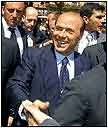
Silvio Berlusconi
In 1989,
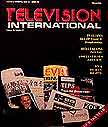
one of the featured stories in TVI Magazine, was about
Silvio Berlusconi -- "Italy's Men of Vision &
Broadcasting and The early years of Berlusconi". The
article written by Dr. Frank Iezzi Ph.D. -- quoted
Berlusconi's statements that: -- "he never hires
anyone over thirty-something".
Silvio Berlusconi's
term as Italy's prime minister in 1994 lasted only
seven stort months, that included a visit to Pasadena,
California, during the World Cup Soccer Championship.
Shortly after the match, the magnate left the office
amid a corruption crackdown.
- 09 May 15, 2001 - Berlusconi is elected ITALY's
PRESIDENT. ROME--As official returns confirmed his
coalition's decisive victory in Italian elections,
Silvio Berlusconi, the flamboyant billionaire tycoon,
filled the airwaves Monday night with the measured
tones of a statesman and humble servant of the
people.
There were no
self-comparisons with Napoleon, no tirades against
Communists, prosecutors, journalists and others on his
enemies list. Instead, he sounded unusually solicitous
and, by his standards, dull.
Having defeated the
leftists who have governed since 1996, Berlusconi is
returning to the prime minister's office with a
stronger mandate than most Italian leaders ever
get--one he pledges to use to modernize the country
with the Midas touch of a man worth $12.8
billion.
But the 64-year-old
media magnate is vulnerable and must watch his every
step. He has been indicted on charges of tax fraud and
bribery of judges. He is under scrutiny for any
conflict between his public duties and vast private
interests. And he is again at the mercy of a fickle
ally whose defection 6 1/2 years ago ended
Berlusconi's previous attempt at governing.
'He Can Be an Irate
Person'
How Berlusconi
navigates these obstacles will determine whether Italy
remains a solid partner in Europe's monetary and
political union, whose leaders tend to view him as an
unsavory interloper, and whether his own country
evolves into a more stable democracy.
"He can be an irate
person," says James Walston, professor of political
science at the American University of Rome. "If he
loses his cool at the wrong time, it could cause some
sort of crisis. Will he survive a five-year term? I
wouldn't bet on it."
The winner's first
steps after Sunday's election were cautious and
low-key.
In remarks taped
for broadcast Monday evening, Berlusconi said Italy is
"proud to be part of the European Union" and will
"work to reinforce those ties."
"We feel the
responsibility of your free choice, and we assure you
we will not let you down," he added.
Nearly complete
returns Monday evening gave Berlusconi's center-right
House of Freedoms alliance firm control of both houses
of Parliament--177 of 324 seats in the Senate and at
least 330 of 630 seats in the lower Chamber of
Deputies.
Adding up hundreds
of local races, pollsters said Berlusconi's forces won
roughly 45% of the popular vote to about 40% for the
center-left Olive Tree coalition led by Rome's
two-term former mayor, Francesco Rutelli.
Rutelli conceded
defeat Monday but pledged that his coalition would
"work day and night" to force Berlusconi to divest
himself of his business empire, which includes Italy's
three biggest private TV networks, its biggest
publishing group and the AC Milan soccer
team.
"That will be our
first real test in opposition," Rutelli
said.
Berlusconi says he
is consulting three foreign "wise men" with the aim of
offering a conflict-of-interest law within his first
100 days in office.
But he and the
center-left have been at odds on the issue,
particularly over a bill that would have allowed
public servants to entrust their property to family
members. Berlusconi, whose two grown children help
manage his holding company, supported the bill, but it
died in Parliament this year.
Rutelli's coalition
also vows to resist a Berlusconi campaign promise to
subject prosecutors, now part of Italy's independent
judiciary, to government control. That effort could
reignite a bitter battle that characterized
Berlusconi's short-lived government in
1994.
Prosecutors began
probing Berlusconi's past business practices while he
was prime minister. His three subsequent convictions
on corruption charges were overturned on appeal. If
prosecutors press the two cases still pending, the
tycoon-turned-prime minister could hide from
prosecution behind his parliamentary immunity or
become Italy's first postwar leader to stand trial
while in office.
"It's not going to
be easy for the prosecutors to keep pursuing such a
popular figure," said Franco Pavoncello, political
scientist at John Cabot University in Rome, "but they
can't just throw out the cases."
Perhaps a bigger
threat to Berlusconi is Umberto Bossi, the volatile
coalition partner whose betrayal brought down
Berlusconi's earlier government. A Berlusconi-inspired
tax break that benefited the tycoon's businesses and
an amnesty that freed his brother from prison were
factors in Bossi's defection.
Bossi is still head
of the Northern League, an extreme right-wing party
whose attacks on illegal immigration border on racism.
The league, which once advocated northern Italy's
secession from the poorer south, saw its support cut
by more than half in Sunday's vote, but its 4% showing
was still pivotal for the center-right
alliance.
Berlusconi insists
that he has tied Bossi to a joint program that
excludes secession or xenophobia, but it is unclear
whether the magnate can control him this time.
'We Hope It Has Not
Been Wasted Sacrifice'
Bossi's top aide,
Roberto Maroni, complained Monday that the compromise
with Berlusconi cost the league votes. "We hope it has
not been wasted sacrifice," Maroni added, vowing to
hold Berlusconi to a pledge to give more power to
local governments. Another right-wing partner, the
National Alliance, is cool to such a
reform.
Because of his poor
showing Sunday, "Bossi's space to maneuver has been
reduced," said Sergio Romano, a conservative
commentator and former ambassador to Russia. "But that
doesn't mean he will stay in line. If he lets
Berlusconi govern well, his party will disappear. He
may have to destroy the coalition before it destroys
him."
Berlusconi declined
to say Monday whether Bossi will get a Cabinet post,
but his presence in the coalition only compounds
Berlusconi's image problem on a continent largely
governed by left-leaning politicians.
His election got a
cool reception in much of Europe. The best many
leaders could say was that Berlusconi's coalition is
not as racist as Joerg Haider's far-right Freedom
Party in Austria and will not by itself prompt the EU
to slap sanctions on Italy as it did on Austria last
year when Haider joined the government.
"The Italian people
have spoken democratically," said French Foreign
Minister Hubert Vedrine. "But we are watching closely
what this government will be and what it will
do."
Because the EU's 15
countries are more closely knit than they were during
Berlusconi's first term, his legal troubles and
potential conflicts of interest will be of more
concern to Italy's neighbors. Because of Europe's
common currency, his business empire is more of a
player on the continental stage.
"Suspicion will
condition his relations with Italy's partners,"
Walston said. "Other European leaders aren't going to
be rude to him, but they'll look at every decision he
and his ministers make, in light of his business
interests, and ask why are they doing it."
///
- 10 Of course today in May 2001, 13 years later,
his taste
for a political life has changed his mind. Billionaire
Silvio Berlusconi's is making a comeback at the age of
64 - to prove a point in Italian society. Some say
it's shameful, others see him as a reformer -- after
coming clean and explaining how and why he became
Italy's first billionaire.
Silvio Berlusconi's term as
prime minister in 1994 lasted only seven stormy
months, that included a visit to Pasadena,
California, during the World Cup Soccor Championship.
But setting that aside, what matters now after his
three subsequent convictions-- were overturned on
appeal--for false business accounting and bribing the
tax police, and the four indictments he still
faces.
Nor does it matter much that
Berlusconi,
Italy's richest person, wants to govern again
without giving up control of the country's three
largest private television networks and the rest of
his corporate empire.
In Italy, where corruption is a
native tradition and "conflict of interest" a foreign
idea, polls make Berlusconi the favorite to lead the
next government after parliamentary elections May
13.
To millions of voters, the
64-year-old tycoon who heads the center-right Freedom
Alliance coalition the mogul from Milan stepped into
the void left when a group of prosecuting magistrates
brought down the parties that had ruled Italy since
the end of World War II. But soon after his election,
he too became a target of the "Clean Hands"
anti-corruption crusade and remained under
investigation after leaving office in
disgrace.
Italy's recovery
from all this upheaval,
though incomplete, is a
European success story. The center-left Olive Tree
coalition elected in 1996 has fixed the
corruption-drained, debt-burdened economy and, to the
surprise of the country's more disciplined neighbors,
met the strict criteria for entering Europe's
single-currency union. Inflation and unemployment have
dropped steadily.
But Berlusconi's own recovery and
his ongoing battle with the magistrates have kept
Italian politics unsettled.
After
the collapse of Benito Mussolini's
wartime dictatorship,
Italians rigged the system in favor of small parties
to prevent anyone from amassing too much power. The
downside was a string of weak, often corrupt
multi-party coalition governments--58 since the
war--whose leaders felt more accountable to each other
than to the electorate.
In the wake of Tangentopoli,
reformers pushed for a U.S.-style two-party system and
a stronger executive. But a bipartisan assembly on
constitutional reform ended in failure two years ago
after the center-left rejected Berlusconi's demand
that the magistrates' powers be weakened.
The deadlock has deflated much of
the initial public enthusiasm for political reform and
weakened voter confidence in the center-left.
The Political
System Is Like Israel's
Like
Israel's 3 party for "political
convenience" system, Italy has the same unwieldy
amalgam Olive Tree convenient system, but has seven
parties, that has bickered its way through three prime
ministers in five years and nominated a fourth man,
former Rome Mayor Francesco Rutelli, 46, to lead its
ticket in next month's vote. Berlusconi, the
consistent voice of opposition for the last 6 1/2
years, outpolls Rutelli by anywhere from 3 to 10
percentage points in recent polls.
"We cleaned up
the country's finances,
but we lost support because
we fell short of our promise to deliver a new kind of
politics," says Sen. Tana de Zulueta, a member of
Rutelli's coalition. "A very large number of Italians
now believe that politics are unreformable, and this
cynicism benefits an outsider like Mr.
Berlusconi."
As the rival coalitions make
similar promises of lower taxes and a freer economy,
Berlusconi has fended off every attempt to make his
wealth, business ethics and would-be conflicts of
interest the central campaign issues.
When an
investigative reporter asserted
on state television that
associates with Mafia ties financed Berlusconi's start
in real estate in the 1970s, the candidate's approval
ratings inched up. Public debate shifted quickly from
mob money to the state channel's right to air such an
allegation, which the candidate denied.
The muted reaction to such
allegations is a measure of public boredom with
Berlusconi's endless legal saga and his success in
casting himself, with help from his TV networks, as a
victim of judicial harassment.
"He's creating
jobs for people,"
said Claudio Valorani,
co-owner of a cafe near the Roman Colosseum. "Let him
work."
Another measure of the tycoon's
comeback is the eclipse of his nemesis, Antonio Di
Pietro, poster boy of the Clean Hands crusade and a
national hero in the 1990s. Today the former
magistrate is a marginal politician leading a tiny
reform party called Italy of Values and running a
long-shot campaign for mayor of Milan.
"Twelve years after the fall of the
Berlin Wall . . . our leaders are still debating left
and right ideology, instead of legality and
illegality," Di Pietro complains. "People are
disillusioned with the way issues of criminality have
become so politicized."
In fact, many
Italians view the magistrates
as politically driven
agents of a state that often makes up for negligence
with sporadic excess. Or they accept Berlusconi's
defense that in the 1980s and '90s, he, "like tens of
thousands of other Italian businessmen, was subjected
to a system of extortion [by the tax police]
that we were powerless to oppose."
"It's amazing, but there's not a
tremendous outcry against Berlusconi," says Franco
Ferrarotti, sociology professor at the University of
Rome. "Deep down, people regard entrepreneurial wealth
as the ultimate proof of success. They distinguish
between him and the old-style politicians, who became
rich by stealing from the state. They don't see you as
a threat to the public good if you spend your own
money to acquire public office."
Berlusconi, whose fortune is
estimated at $12.8 billion by Forbes magazine, is busy
these days doing just that.
Kicking off his
campaign this month,
he spent an estimated $20
million to publish his biography in the form of a
128-page magazine and mail a copy to each of Italy's
12 million households.
"An Italian
Story," featuring gauzy
photographs of the bronzed, smiling tycoon with his
family, employees, voters and world leaders, depicts a
self-made man achieving Italy's version of the
American dream--corporate and political power, without
the burden of American-style laws forcing one to
choose between the two.
Because Italian industrialists were
traditionally content to manipulate politics from
behind the scenes, the term "conflict of interest" was
rarely heard in Italian before Berlusconi's brief
stint in office made it an issue. Italians now talk
about conflitto d'interessi but are still struggling
to grasp the concept.
Three years ago, in the spirit of
bipartisan reform, the tycoon went along with a bill
that would require entrepreneurs who join the
government to sell their assets or place them in blind
trusts. The bill passed the Chamber of Deputies,
Italy's lower house of Parliament, but stalled in the
Senate until two months ago, when it was amended to
bar such sales to one's relatives.
Berlusconi, who
has five children,
objected to the change, and
the bill died after returning to the lower house. If
elected again, he says, he would do what he did last
time: hand over his holding company, Fininvest,
temporarily to his second-in-command. Fininvest
controls his TV networks, Italy's largest publishing
group, a film company and the AC Milan soccer
team.
Influential conservatives have
warned, however, that his every act as prime minister
might come under scrutiny if he failed to divest
himself of such diverse holdings. He would wind up,
they note, controlling every major TV network, public
and private--a concentration of media power almost
unheard of in the West.
"He will be
forced to spend much of his time
explaining that he doesn't
use his companies to further his political battles and
that he doesn't use his public position to favor his
business," Sergio Romano, a conservative commentator
and former Italian ambassador to the Soviet Union,
wrote in the newspaper Corriere della Sera.
Voters care far less. Berlusconi's
dynamic image adds credibility to his promises for
economic growth, public works and
modernization.
"I'm sure that everyone in politics
has conflicts of interest," says Roberto Di Carlo, who
runs a small transport company in Rome. "The other
side must have its own private interests--it just
doesn't let you see them. But let's allow Berlusconi
to govern for five years. I'd like to compare the
results."
///
A
New Way To Advertise -
Our 24-hour, 365
days-a-year smart90 number -can be your portal to the
web to introduce your movies to the world -- on
look@Smart90.©om™
Advertise
Now -
Send
your insertion orders and advertising copy or requests
to the attention of Bernie Schwartz, Advertising Sales
Director, at tvi@Smart90.©om™
Accompanying slides, transparencies, illustrations,
photographs, or other computer graphic art and/or
complete separations, can be E-mailed to our art
department, if you wish. Any items mailed will be
returned or forwarded. Advertising material must be
received by the 10th of every other month to be
included in the following issue.
Please
do not hesitate to call me at 323 462-1099, for
further information.
Respectfully,
Josie
Cory, Publisher , Editor TVI
Legal
Notices Copyright
Information
How
Do We Do Business?
Tel/Fax
702 798-8778 or 323 462-1099

 com/berlusconiart90products