Total
News Udates -
Clicks
/
•
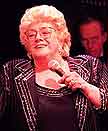
Rosemary
Clooney, whose warm, radiant voice placed her in the first
rank of American popular singers for more than half
a century, died, July 29, 2002 at her home in
Beverly Hills. She was 74.
The cause was complications from lung
cancer, according to her spokeswoman, Linda
Dozoretz.
•••
Ms.
Clooney did not dig as deeply into the
emotional content of a song as Frank Sinatra did;
she never tried to emulate the sound and delivery
of an instrument as Mel Tormé seemed to do
so easily; she did not burst into the scat choruses
favored by Ella Fitzgerald. But she sang with so
much assuredness, simplicity and honesty that these
elements became her trademark and endeared her to
audiences and critics alike. In the words of the
director Mike Nichols, "She sings like Spencer
Tracy acts." Part
02
/
•••
In recent years Ms. Clooney had been appearing in
the best cabarets and on concert stages, largely
with small groups, singing pop-jazz standards that
earned her new audiences and renewed respect.
Reviewing a performance at Michael's Pub in
Manhattan, Stephen Holden of The New York Times
said of her: "Her special strength is an ability to
infuse everything she touches with warmth,
intelligence and a subtly swinging energy that make
her interpretations of standards models of balance
and clarity. Her emotional perspective is dry-eyed
and perceptive. Rather than acting out the romantic
dramas of well-known song lyrics, she projects an
understanding that is almost maternal in its blend
of wisdom and empathy."
•••
Although she did her best work singing standards
with a fidelity to their composers, Johnny Mercer
and Harold Arlen, Cole Porter, Duke Ellington,
George and Ira Gershwin, Johnny Burke, Jimmy Van
Heusen and Richard Rodgers and Lorenz Hart, her
beginnings were decidedly in a genre not nearly so
distinguished. She became one of America's
best-known popular singers in 1951 with a novelty
called "Come-on-a-My House," which became a huge
hit record, and followed that with other novelties
like "Botcha-Me," "Mambo Italiano" and "This Old
House," songs that her audiences always wanted to
hear long after she was pursuing a less-flamboyant
repertory.
•••
Some fans even occasionally asked her to sing "How
Much Is That Doggie in the Window?" a novelty that
belonged to Patti Page, never to Rosemary Clooney.
"They probably figure if it's a bad song I must
have done it," she once said about her earlier
recording career.
•••
But even then Ms. Clooney recorded pensive ballads
like "Tenderly" and "Hey There" with such
simplicity and beauty that they also became songs
indelibly associated with her. Ms. Clooney with a
good ballad was always approachable and
intimate.
•••
Her early career reached a height in 1954 when she
appeared opposite Bing Crosby and Danny Kaye
singing Irving Berlin songs in the hit musical
"White Christmas." But her good looks and cheery
disposition masked a life with more than its share
of pain. Part
03
/ •
•••
She survived a disastrous marriage to the actor
Jose Ferrer; she was scarred by the assassination
of her friend Robert Kennedy, which she witnessed
first hand; she abused drugs and had affairs that
disappointed and wounded her; she had a childhood
of uncertainty with an affably alcoholic father and
a mother who eventually deserted the family.
•••
And yet Ms. Clooney never completely lost her
admiration for Mr. Ferrer, the father of her five
children, whom she married and divorced twice, not
even after she learned of his womanizing during
their marriage that led her to conclude that he was
breaking her heart "in small increments." And she
always made a place in her home for the parents who
had not done the same for her when she was a
child.
•••
She was nominated for an Emmy award for an
appearance on "E.R.," the series that featured her
nephew George Clooney, and this year she was given
a lifetime achievement Grammy award a month after
she was hospitalized for lung cancer surgery.
•••
Rosemary Clooney was born May 23, 1928, in
Maysville, Ky., a small town on the Ohio River
southeast of Cincinnati. She was one of five
children born to Andrew and Frances Guilfoyle
Clooney. Mr. Clooney was a house painter who drank
so much and so often that his own father, a jeweler
who served several terms as mayor of Maysville, had
his son jailed for public drunkenness. One of the
Clooney children, Andy, drowned as a boy swimming
in the Ohio River. But the others survived and
remained close. They included Betty, who sang
professionally for a while with Rosemary; and Nick,
who became a television performer. Another sibling,
Gail, did not venture into show business.
•••
When Rosemary was 10 and in the fourth grade, she
made her acting debut in a school production of
"Snow White and the Seven Dwarfs," in which she
played the witch. That same year her paternal
grandmother died, sending her father into an
intensified period of drinking. Rosemary and her
siblings were sent to live with her mother's
family, the Guilfoyles. After Rosemary completed
the sixth grade her grandmother took her to
Ironton, Ohio, east of Maysville. Two years later,
they moved to Cincinnati.
•••
Rosemary and her sister Betty began to sing
publicly, at first for political rallies for her
grandfather, who was mayor of Maysville, later at
amateur contests throughout northern Kentucky and
southern Ohio.
•••
When Rosemary was in high school and Betty was in
junior high, radio station WLW in Cincinnati
conducted a talent contest. The sisters won and for
a time were heard seven nights a week, earning $20
each.
•••
The sisters began to sing with Barney Rapp's big
band, which performed around Cincinnati. An agent
for Tony Pastor heard them, and for the next three
years the Clooney Sisters became vocalists for the
Pastor big band.
•••
Grandmother Guilfoyle , who sewed as well as she
could cook, made them dresses, and one of their
uncles, George Guilfoyle, accompanied them on the
band bus to make certain that they were not led
astray by any of Mr. Pastor's musicians.
•••
In 1946 Rosemary Clooney made her first solo
recording, "I'm Sorry I Didn't Say I'm Sorry When I
Made You Cry Last Night," which attracted attention
because she sang it in a whisper that disk jockeys
speculated was going to be the new style. In
reality, she had been so petrified when she stood
before the microphone that she could not sing the
song in full voice as she had intended.
•••
By 1947 she was gaining notice. Downbeat magazine
said she had "an extraordinarily good voice,
perhaps the nearest thing to Ella Fitzgerald we've
ever heard." In 1948 Betty Clooney quit the Pastor
band. Rosemary stayed another year before she left,
hopeful of success because she had signed a
contract with Columbia Records. The initial deal
was that she would be paid $50 a recording, no
matter how many copies it sold. 4.
•••
In 1950 she attracted favorable attention with an
appearance on the "Songs for Sale" television show
and with her recording of "Beautiful Brown Eyes,"
her first real hit for Columbia. She started to
appear regularly on television, including the Ed
Sullivan show.
•••
But her first megahit came the next year, when
Mitch Miller, the artist and repertory man at
Columbia, persuaded her to sing "Come On-a My
House." The song was based on something old and
Armenian, updated by the novelist William Saroyan
and Ross Bagdasarian, who later changed his name to
David Seville and created the Chipmunks. From the
instant that Ms. Clooney heard it she thought it
was dreadful and told Mr. Miller she would not sing
it, but he insisted, hinting broadly that if she
refused, her career at Columbia might come to an
end. The recording became a runaway best seller,
and Ms. Clooney became a star.
•••
The success emboldened Mr. Miller to assign her to
other novelty songs, most notably "Botcha Me" and
"Mambo Italiano," which also became hits. When she
made her screen debut in "The Stars Are Singing,"
she was trumpeted as "the next Betty Hutton," and
she made the cover of Time magazine in 1953 with
her bouncier image.
•••
"I always wanted to sing sad ballads, but I didn't
get many opportunities," Ms. Clooney once told
Stephen Holden of The Times. "If I found something
I wanted to do, I had to get permission. At the
same time, you can't quarrel with success. If it
hadn't been for `Come on-a My House,' I probably
wouldn't be here now."
•••
Ms. Clooney remained busy and successful for the
rest of the 1950's. She fell in love with Dante
DiPaolo, a dancer at Paramount studios, but jilted
him to marry Mr. Ferrer in 1953 and to make more
movies, including "White Christmas" in 1954 with
Bing Crosby, Danny Kaye and Vera-Ellen.
•••
In the early 1960's she and Mr. Ferrer became
estranged, she had an affair with the arranger
Nelson Riddle that went nowhere (he was married and
the father of six children) and she slowly became
addicted to sleeping pills. Her work habits became
erratic, and she got tagged as being undependable.
She found it difficult to find work. Her singing
deteriorated.
•••
By the end of the decade, she was "dead behind the
eyes," she recalled in her 1977 memoir, "This for
Remembrance." "The records I did then sound like
they were made underwater. I misbehaved with
everyone, onstage and off." Her divorce from Mr.
Ferrer became final in 1967.
•••
In 1968 she supported the presidential aspirations
of Senator Robert F. Kennedy and was standing near
him when he was shot to death in Los Angeles by
Sirhan Sirhan. Ms. Clooney, recalling the day in
her memoir, said she was convinced that he hadn't
died, that it was somehow all a big hoax.
•••
Her self-destructive rampage continued until she
spent a month in the psychiatric ward of Mount
Sinai Hospital in Los Angeles. And when she
emerged, she was short of money and supported
herself by singing for anyone who would pay her.
Mostly it was weekend work at Holiday Inns.
•••
Her fortunes changed again in 1974 when Crosby
asked her to appear with him at a show marking his
50th anniversary in show business. She did well and
then made several successful tours with him and
also toured with Margaret Whiting, Helen O'Connell
and Rose Marie in a show called "4 Girls 4."
•••
She suffered a setback in 1976 when her sister
Betty died of an aneurysm but regained control of
herself and worked on her memoirs.
•••
Unexpectedly she ran into Mr. DiPaolo, who moved in
with her and became her road manager, and in 1996
she married him in the church in Maysville where
she had been baptized.
•••
In the 1990's she recorded many songs for the
Concord Jazz label, and the critics agreed that her
voice had gotten better.
•••
She is survived by her husband, Mr. DiPaolo; three
sons, the actor Miguel Ferrer; Gabriel Ferrer, a
painter and Episcopal priest married to Debby
Boone; and the voice-over actor Rafael Ferrer; two
daughters, Maria Murdoch, a designer; and Monsita
Teresa Botwick; 10 grandchildren, her brother, Nick
Clooney, and her sister, Gail Clooney Darley.
•••
When she was in her 60's, Ms. Clooney said, "If you
hang around long enough, you get a lot of good
stuff." Most of the time, she added, her life was
pretty good.
•••
Bloomberg, New York Times and Reuters were used in
compiling this report.
•••
5.
Related Stories•
Rosemary
Clooney
born May 23, 1928 - d.
June 29, 2002
Born - Maysville, Kentucky -
Respectfully
Submitted

 Total
News Udates -
Clicks
Total
News Udates -
Clicks