top
ˆ
top
ˆ
•
top
ˆ
top
ˆ
•
top
ˆ
top
ˆ
•
top
ˆ
top
ˆ
•
top
ˆ
top
ˆ
top
ˆ
•
top
ˆ
top
ˆ
|
106 NBS100
TELECOM Reglatory Timeline - 1887 to 2005 - Regulatory
Missteps / 1913 -
Kingsbury Commitment • FCC Federal Communications
Commission
T• •
Until the Internet came along and the
freebie Google, Yes90 and Yahoo almanacs became part the
Telecom learning process, practitioners have had to rely on
paralegal teams in Washington, D.C. -- to tease modern
meaning out of the aging provisions of the Communications
Act of 1934, which itself had origins in the Interstate
Commerce Act of 1887 and the Radio Act of 1927 - established
by an
Act
of CONGRESS.
1887 - The United
States Interstate Commerce
Act
•• • The
United States Interstate Commerce Act of 1887 was created
the Interstate Commerce Commission. The members of the
commission were appointed by the President with the consent
of the Senate. This was the first of the so-called Fourth
Branch agencies. Its aim was to regulate surface
transportation (initially railroads, later trucking), to
ensure fair prices and regulate other aspects of the conduct
of common carriers. The Interstate Commerce Commission
started in trouble, since the ICC was given a mandate to
manage interstate commerce, but was not authorized to
enforce the law. The ICC started as a regulatory body
without power, basically. The ICC's powers were expanded by
subsequent laws.
• • Its creation was a result of the 1886
United States Supreme Court case of Wabash, St. Louis &
Pacific Railroad Company v.
Illinois.
• • The act was signed into law by
President Grover Cleveland.
• • Between 1910 and 1934, the ICC also had
the power to regulate interstate telephone services,
although it did little to exercise this power. Under the
Communications Act of 1934, this authority was transferred
to a new Federal Communications
Commission.
•• • The Interstate Commerce
Commission is often cited as a classic example in which an
agency intended to protect consumers is "captured" by the
industry that it intended to regulate. The Commission was
accused of acting in the interests of the trucking industry
by causing prices to be set at artificially high levels and
by using regulation to prevent new entrants from
competing.
•• • It was replaced by the Surface
Transportation Board in 1995, after losing much of its
strength due
1913 - Kingsbury Commitment
-1913
• •
The
Kingsbury Commitment of 1913 marked the beginning of
AT&Ts monopoly. The Bell System and independent
telephone operators reduced competition out of concern for
government intervention. The government had been
increasingly worried that AT&T and the other Bell
Companies were monopolizing the
industry.
• • Under
Theodore N. Vail from 1907 AT&T had bought
Bell-associated companies and organized them into new
hierarchies. AT&T had also acquired many of the
independents, and bought control of Western Union, giving it
a monopolistic position in both telephone and telegraph
communication. It is also credited with using almost illegal
methods to eliminate competition. Vail stated that there
should be "one policy, one system (AT&T's) and universal
service, no collection of separate companies could give the
public the service that [the] Bell... system could
give." Faced with a government investigation for antitrust
violations AT&T had to act.
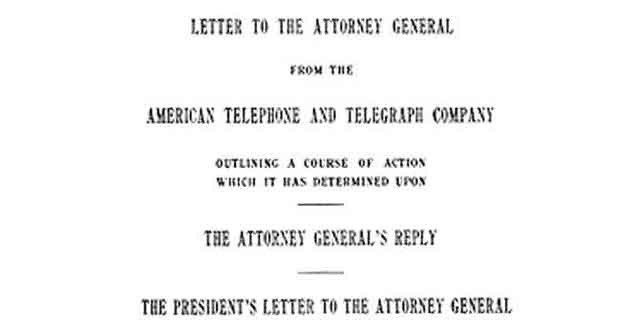
• • In the Kingsbury Commitment, actually a
letter from AT&T VP Nathan Kingsbury of December 9,
AT&T agreed with the Attorney General to divest itself
of Western Union, to provide long-distance services to
independent exchanges under certain conditions and to
refrain from acquisitions if the Interstate Commerce
Commission objected.
• • The Commitment did not settle all the
differences between independents and Bell companies and
averted the federal takeover many had expected. However the
Commitment played into AT&T's hands - the company was
allowed to buy market-share, as long as it sold an equal
number of phones. So AT&T was able to consolidate its
hold on the most profitable urban markets, and
interconnection only strengthened its hand in long-distance
traffic. Between 1921 and 1934 the ICC approved 271 of the
274 purchase requests of AT&T.
• • The entire network was nationalised
during World
War I from June 1918 to July 1919. Following
re-privatization, AT&T resumed its near-monopoly
position. In 1934, the government acted to set AT&T up
as a regulated monopoly under the jurisdiction of the
Federal Communications Commission. This
was maintained until AT&T's forced divestiture in
1984.
• • See
also: Hall Memorandum , United States Telephone Association
, Sherman Antitrust Act, Willis Graham Act ,
 •
• /// •
• ///
1927
- Federal Radio
Commission
• • The Federal Radio
Commission (FRC) was a government body that regulated radio
broadcasts in the United States from its creation in 1927
until its replacement by the Federal Communications
Commission (FCC) in 1935. The Commission was created to
license broadcasters and reduce radio interference, a
benefit to both the broadcasters and the public. The Radio
Act of 1927 superseded the Radio Act of 1912 , which had
given regulatory powers over radio communication to the
Secretary of Commerce and Labor. The Radio Act of 1912 did
not mention broadcasting and limited all private radio
communications to what is now the AM band.
• • The Radio Act
of 1927
• • The Radio Act of
1927 (signed into law February 23, 1927) made almost no
mention of the radio networks that were in the process of
dominating radio. The only mention of radio networks was
vague: The Commission {the Federal Radio Commission} shall
"Have the authority to make special regulations applicable
to stations engaged in chain broadcasting." Advertising was
mentioned in the act with only slightly more authority than
networking; merely requiring advertisers to identify
themselves: "All matter broadcast by any radio station for
which service, money, or any other valuable consideration is
directly paid, or promised to, or charged to, or accepted
by, the station so broadcasting, from any person, firm,
company, or corporation, shall at the time the same is so
broadcast, be announced as paid for or furnished as the case
may be, by such person, firm, company, or corporation."
• • The act did not
authorize the Federal Radio Commission to make any rules
regulating advertising. The content of any programming could
not have "obscene, indecent, or profane language." Otherwise
anything could be programmed, though the Federal Radio
Commission could take into consideration programming when
renewing licenses. A forerunner of the "equal time rule "
was stated in section (18) of the Radio Act of 1927 which
ordered stations to give equal opportunities for political
candidates. The act did vest in the Federal Radio Commission
the power to revoke licences and give fines for violations
of the act.
• • The Radio Act of
1927 divided the country into five zones. Each was to have
one person to be on the commission. The Davis amendment to
the act required that each zone was to have equitable
allocations of licenses, time of operation, station power,
and wavelength. This greatly complicated things for the
commissioners; e.g. the northeast had a greater population
than the southwest, thus a greater need, but it still had to
have as many stations as the southwest.
• • On February 25,
1928 Charles Jenkins Laboratories of Washington, DC became
the first holder of a television license from the Federal
Radio Commission.
• • Formation of
the Commission
• • President Calvin
Coolidge nominated five men to the commission: Admiral
W.H.G. Bullard as chairman, Colonel John F. Dillon , Eugene
O. Sykes, Henry A. Bellows , and Orestes H. Caldwell .
• • The first three
were confirmed by the Senate and the first two died soon
afterward. Bellows and Caldwell didn't receive salaries, but
stayed on anyway. These three did conduct a badly needed
reallocation of frequencies. In October Bellows left the
commission to return to Minneapolis where he had been a
broadcaster. In November 1927 Harold Lafount and Sam Pickard
joined the commission. In March 1928 Caldwell was barely
confirmed and Ira Robinson became chairman, the commission
was finally complete.
• • Radio
Licensing
• • In the spring of
1928, the commissoners made drastic reallocations and told
164 stations to justify their existence or be forced to stop
broadcasting. Eighty-one stations did survive, most with
reduced power. Educational stations didn't fare very well.
They were usually required to share frequencies with
commercial stations and operate during the daytime, which
was considered worthless for adult education.
• • KFKB Milford,
Kansas had been renewed several times by the Federal Radio
Commission. It was the most popular station in the nation.
KFKB was owned by a "surgeon" who, among other things,
espoused, over the airwaves, goat glands as a cure for
various illnesses. The American Medical Association was very
upset over his prescriptions, so in 1930 the Federal Radio
Commission denied his request for renewal. Dr. John Brinkley
, the "surgeon", appealed on the grounds of censorship. The
U.S. Court of Appeals denied his appeal. The court ruled
that the Federal Radio Commission could consider past
programming content without it being censorship. This,
however, didn't stop the ever-popular Dr. Brinkley, who
almost won the governorship of Kansas in 1928 by write-in
votes. He simply beamed his programs to the United States
over 100,000 watt XER Mexico. This was twice the power of
any broadcast radio station save one experimental 500,000
watt station WLW Cincinnati.
• • WNYC, the
municipal station of New York City, was assigned a
part-time, low-power channel. It appealed and lost. Even
though the station was government owned, the Federal Radio
Commission said that city ownership did not give the station
any special standing concerning the "public interest,
convenience, and necessity." This was representative of the
decline of public broadcasting. Both cases asserted the
right of the Federal Radio Commission.
1934 - FCC - Federal
Communication Commission
In Congress passed the
Communications Act, which remained unchanged for almost
sixty years. The Federal Communications Commission, created
by the act replaced the Federal Radio Commission.
Communications
Act of 1934 - The U.S.
Communications Act of 1934 replaced the Federal Radio
Commission with the Federal Communications Commission.
• • Before passage,
there was an interesting debate in Congress. Senators Robert
Wagner of New York and Henry Hatfield of West Virginia
offered an amendment to the then proposed Communications
Act. Educators wanted more of radio to be given to them;
they had been termed a "special interest" by the Federal
Radio Commission and their stations were forced to share
frequencies. This amendment would have given 25% of all
radio broadcasting facilities to non-profit institutions and
organizations. It would also have allowed these educational
stations to sell advertising in order to become
self-sufficient. Senator C.C. Dill , a pro-industry
spokesman opposed this amendment. It would have meant
eliminating numerous commercial stations, but that is not
what Dill publicly complained about. He expressed horror
over the advertising. He said there was too much advertising
already. Not all educators supported the advertising clause,
so a compromise was struck. The issue was to be given to the
new Federal Communications Commission to study and to hold
hearings on and to report back to Congress. Hatfield and
Wagner stuck to their guns, however, and proposed the bill
anyway, the Hatfield-Wagner amendment died and the
Communications Act was passed.
• • The Federal
Communications Commission reported back, saying that
commercial stations had ample time for educational and other
public service programs. The Commission called for
cooperation between commercial and educational interests and
other non-profit groups. The educators lost, but the
commercial broadcasters didn't exactly win; they had to put
on public affairs programs.
• •
///
1934
- FCC Federal Communications
Commission
• •
Regulatory powers
• • The Federal
Communications Commission has one major regulatory weapon,
revoking licenses, but short of that has little leverage
over broadcast stations. It is reluctant to do this since it
operates in a near vacuum of information on most of the tens
of thousands of stations whose licences are renewed every
three years. Broadcast licenses are supposed to be renewed
if the station meets the "public interest, convenience, or
necessity."
• • The Federal
Communications Commission rarely checks except for some
outstanding reason; burden of proof would be on the
complainant. Fewer than 1% of station renewals are not
immediately granted, and only a small fraction of those are
actually denied.
• • Note: Similar
authority for regulation of Federal Government
telecommunications is vested in the National
Telecommunications and Information Administration (NTIA).
• • The Federal
Communications Commission (FCC) is an independent United
States government agency, created, directed, and empowered
by Congressional statute.
• • The FCC was
established by the Communications Act of 1934 as the
successor to the Federal Radio Commission and is charged
with regulating all non-Federal Government use of the radio
spectrum (including radio and television broadcasting), and
all interstate telecommunications (wire, satellite and
cable) as well as all international communications that
originate or terminate in the United States. The FCC took
over wire communication regulation from the Interstate
Commerce Commission. The FCC's jurisdiction covers the 50
states, the District of Columbia, and U.S. possessions.
The Body of the Organization
• • The FCC is
directed by five Commissioners appointed by the President
and confirmed by the Senate for 5-year terms, except when
filling an unexpired term. The President designates one of
the Commissioners to serve as Chairperson. Only three
Commissioners may be members of the same political party.
None of them can have a financial interest in any
Commission-related business.
• • As the chief
executive officer of the Commission, the Chairman delegates
management and administrative responsibility to the Managing
Director. The Commissioners supervise all FCC activities,
delegating responsibilities to staff units and Bureaus. The
current FCC Chairman is Michael Powell, son of former
Secretary of State Colin Powell. The other four current
Commissioners are Kathleen Abernathy , Michael Copps , Kevin
Martin , and Jonathon Adelstein .
History - Report on
Chain Broadcasting
1940 -
In 1940 the Federal
Communications Commission issued the "Report on Chain
Broadcasting." The major point in the report was the breakup
of NBC (See American Broadcasting Company), but there were
two other important points. One was network option time, the
culprit here being CBS. The report limited the amount of
time during the day, and what times the networks may
broadcast. Previously a network could demand any time it
wanted from an affiliate. The second concerned artist
bureaus. The networks served as both agents and employees of
artists, which was a conflict of interest the report
rectified.
Allocation of television
stations
• • The Federal
Communications Commission assigned television the very high
frequency (VHF) band and gave TV channels 1 to 13. The 13
channels could only accommodate 400 stations nationwide and
could not accommodate color in its state of technology in
the early 1940s.
1940 -
In 1944 CBS proposed to
convert all of television to the ultra high frequency (UHF)
band, which would have solved the frequency and color
problem. There was only one flaw in the CBS proposal:
everyone else disagreed. In 1945 and 1946 the Federal
Communications Commission held hearings on the CBS plan. RCA
said CBS wouldn't have its color system ready for
5&endash;10 years. CBS claimed it would be ready by the
middle of 1947. CBS also gave a demonstration with a very
high quality picture.
1945 -
In 1945 the Federal
Communications Commission moved FM radio to a higher
frequency. The Federal Communications Commission also
allowed simulcasting of AM programs on FM stations.
Regardless of these two disadvantages, CBS placed its bets
on FM and gave up some TV applications. CBS had thought TV
would be moved according to its plan and thus delayed.
Unfortunately for CBS, FM was not a big moneymaker and TV
was. That year the Federal Communications Commission set 150
miles as the minimum distance between TV stations on the
same channel.
1946 -
In October of 1946 RCA
presented a color system of inferior quality which was
partially compatible with the present VHF black and white
system.
1947 -
In March 1947 the Federal
Communications Commission said CBS would not be ready, and
ordered a continuation of the present system. RCA promised
its electric color system would be fully compatible within
five years; in 1947 an adapter was required to see color
programs in black and white on a black and white set.
1948 -
There was interference
between TV stations in 1948 so the Federal Communications
Commission froze the processing of new applications for TV
stations.
• • On September 30,
1948, the day of the freeze, there were thirty-seven
stations in twenty-two cities and eighty-six more were
approved. Another three hundred and three applications were
sent in and not approved.
• • After all the
approved stations were constructed, or weren't, the
distribution was as follows: New York and Los Angeles, seven
each; twenty-four other cities had two or more stations;
most cities had only one including Houston, Kansas City,
Milwaukee, Pittsburgh, and St. Louis.
• • A total of just
sixty-four cities had television during the freeze, and only
one-hundred-eight stations were around. The freeze was for
six months only, initially, and was just for studying
interference problems. Because of the Korean Police Action,
the freeze wound up being three and a half years.
• • During the
freeze, the interference problem was solved and the Federal
Communications Commission made a decision on color TV and
UHF. In October of 1950 the Federal Communications
Commission made a pro-CBS color decision for the first time.
• • The previous RCA
decisions were made while Charles Denny was chairman. He
later resigned in 1947 to become an RCA vice president and
general counsel. The decision approved CBS' mechanical
spinning wheel color TV system, now able to be used on VHF,
but still not compatible with black-and-white sets.
1951 -
RCA, with a new compatible
system that was of comparable quality to CBS' according to
TV critics, appealed all the way to the U.S. Supreme Court
and lost in May 1951, but its legal action did succeed in
toppling CBS' color TV system, as during the legal battle,
many more black-and-white television sets were
sold
• • When CBS did
finally start broadcasting using its color TV system in
mid-1951, most American television viewers already had
black-and-white receivers that were incompatible with CBS'
color system. In October of 1951 CBS was ordered to stop
work on color TV by the National Production Authority ,
supposedly to help the situation in Korea. The Authority was
headed by a lieutenant of William Paley, the head of CBS.
1951 -
The Federal Communications
Commission, under chairman Wayne Coy, issued its Sixth
Report and Order in early 1952. It established seventy UHF
channels (14 to 83) providing 1400 new potential stations.
It also set aside 242 stations for education, most of them
in the UHF band.
• • The Commission
also added 220 more VHF stations. VHF was reduced to 12
channels with channel 1 being given over to other uses and
channels 2&endash;12 being used solely for TV, this to
reduce interference. This ended the freeze.
1953 -
In March of 1953 the House
Committee on Interstate and Foreign Commerce held hearings
on color TV. RCA and the National Television Systems
Committee , NTSC, presented the RCA system. The NTSC
consisted of all of the major television manufacturers at
the time. On March 25, CBS president Frank Stanton conceded
it would be "economically foolish" to pursue its color
system and in effect CBS lost.
• • On December 17,
1953, the Federal Communications Commission reversed its
decision on color and approved the RCA system. Ironically,
color didn't sell well. In the first six months of 1954 only
8,000 sets were sold; compared with 23,000,000 black and
white sets. Westinghouse made a big, national push and sold
thirty sets nationwide. The sets were big, expensive and
didn't include UHF.
• • The problem was
that UHF stations would not be successful unless people had
UHF tuners, and people would not voluntarily pay for UHF
tuners unless there were UHF broadcasters. Of the 165 UHF
stations that went on the air between 1952 and 1959, 55%
went off the air. Of the UHF stations on the air, 75% were
losing money. UHF's problems were the following:
• • (1) technical
inequality of UHF stations as compared with VHF stations;
• • (2) intermixture
of UHF and VHF stations in the same market and the millions
of VHF only receivers;
• • (3) the lack of
confidence in the capabilities of and the need for UHF
television. Suggestions of de-intermixture (making some
cities VHF only and other cities UHF only) were not adopted,
because most existing sets did not have UHF capability.
Ultimately the FCC required all TV sets to have UHF tuners
under the All Channels Act. However over four decades later,
UHF is still considered inferior to VHF, despite cable
television, and ratings on VHF channels are generally higher
than on UHF channels.
• • The allocation
between VHF and UHF in the 1950s, and the lack of UHF tuners
is entirely analogous to the dilemma facing digital
television fifty years later in the 2000s. The All Channels
Act is again being used to force this transition, however at
significantly greater cost to the consumer this time around.
• • Source: from
Federal Standard 1037C
• • See also:
concentration of media ownership, Fairness Doctrine,
frequency assignment, open spectrum, British equivalent
Ofcom, Mercedes Divide
• •
From
Wikipedia, the free
encyclopedia.
ODDBALL
TELECOM STORY
• •
///
1996
- Telecommunications Act of
1996 -
Telecommunications
Act of 1996 -
Telecommunications Act of 1996 is the largest major revision
of the law governing how communications industries are
regulated in the United States, since the Communications Act
of 1934.
• • The industries
directly affected by the law include: over-the-air
television and radio stations, cable television operators,
satellite broadcasters, wireline telephone companies (local
and long distance), wireless telephone companies, and
others.
• • The general
intent of the revision is summarized, among experts, as
deregulation and promotion of facility-based competition .
Many agree that the Telecom Act has not fulfilled those
goals well. Yet there are contradictory accounts as to how
and why it has failed, what should be done.
• • Title V was the
Communications Decency Act, the child protection portions of
which were subsequently struck down, leaving the legal
protection against liability for the words of
others.
///
ByLines:
Editors Note
More Stories •
Converging
News 162005 / TeleCom Buy Outs and Asset Seizure
Boom
Respectfully
Submitted
Josie
Cory
Publisher/Editor
TVI Magazine
TVI Magazine,
tviNews.net, YES90, Your Easy Searh, Associated Press,
Reuters, BBC, LA Times, NY Times, VRA's D-Diaries, Industry
Press Releases, They Said It and SmartSearch were used in
compiling and ascertaining this Yes90 news report.
©1956-2005. Copyright. All rights
reserved by: TVI Publications, VRA TelePlay Pictures, xingtv
and Big Six Media Entertainments. Tel/Fax: 323
462.1099.
We Preserve The
Moment
Return
ˆ
To Top
|
|
We Preserve The
Moment
Yes90 tviNews
•
106
NBS100 TELECOM STUDY - 1887 to 2005 - Regulatory
Missteps / 1913
- Kingsbury Commitment • FCC Federal
Communications Commission
/ Ted
Turner Television International Magazine's Person
Of The Week POW58 •
162005 - /
Ted Turner / Front Cover Vol
49-POW58
•
TVI 61 Cover Photo:
Feature
Story
•
NEWS
Convergence - 16th Week of 162005
/ •
106FCCKingsburyTimeline.htm
• Smart90, s90tv, lookradio, tvimagazine,
dv90, vratv, xingtv, Ddiaries, nbs100, Look Radio,
Josie Cory, Television
With No Borders
|
|
|
|
Legal
Notices Copyright
Information
How
Do We Do Business?
Tel/Fax
323 462-1099
SEND
E-MAIL
Return
ˆ
To
Top
|
|
|