|
1.
Feature
Story
/A
LOOK AT
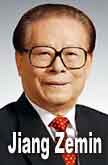
Jiang
Zemin
-
A
Short
Biography.
•
•
For
over 15 years,
Jiang
Zémín
was the "core
of the third
generation" of
Communist Party
of China
leaders,
serving as
General
Secretary of
the Communist
Party of China
from 1989 to
2002, as
President of
the People's
Republic of
China from 1993
to 2003, and as
Chairman of the
Central
Military
Commission from
1989 to 2004.
•
It
Was In June
1989 that . .
.
Jiang
Zemin was
elected General
Secretary of
the CPC Central
Committee, and
became
President of
the People's
Republic of
China
and Chairman of
the Central
Military
Commission.
•
•
His
theory of the
Three
Represents has
been written
into the party
and state
constitutions.
Under his
leadership,
China
experienced
substantial
economic growth
with reforms
and improved
its relations
with the
outside world
while the
Communist Party
maintained its
tight control
over the
government.
•
•
The books are a
testament to
Jiang's hybrid
persona during
his time in
office as
leader of a
communist
dictatorship
that crushed
any challenge
to its monopoly
on power and a
globe-trotting
bon
vivant.
•
•
His
travel book,
"For a Better
World: Jiang
Zemin's
Overseas
Visits,"
includes 167
pictures of
Jiang with
leaders
including
former
President Bill
Clinton and
South Africa's
Nelson Mandela.
It describes
Jiang's
campaign in the
early 1990s to
thaw ties with
the United
States and the
West and end
the diplomatic
isolation
imposed on
Beijing after
it crushed
pro-democracy
protests in
1989 -- an
incident that
the book avoids
discussing.
Jiang
as a statesman
of the new
generation
has
the distinct
makings and
style of a
scholar. He has
extensive
knowledge. He
loves reading,
and the most he
reads are the
latest books on
economics,
science and
technology,
politics and
culture. While
in office in
Shanghai, he
wrote papers
such as On the
New Features of
the Development
of World
Electronic
Information
Industry and
the Strategic
Problems of the
Development of
China's
Electronic
Information
Industry, The
Trend of Energy
Development in
the World and
the Main
Energy-Saving
Measures, which
were published
in the
"Shanghai
Jiaotong
University
Journal."
He
can use
English,
Russian
and
Romanian, and
knows some
German and
Japanese. In
meeting with
foreign guests,
he often
expresses his
viewpoints in
foreign
languages. He
is highly
accomplished in
famous works of
classic Chinese
literature and
often quotes in
talks
well-known
lines from
exponents of
various schools
of thought as
well as Tang,
Song and Yuan
poetry. He also
reads
extensively
famous works of
Western
literature.
He
loves to read
novels by Mark
Twain,
and
can recite
passages from
"Hamlet" by
Shakespeare and
verses from
"Ode to the
West Wind" by
Shelley. He
also knows very
well works by
Leo Tolstoy,
Pushkin,
Chekhov and
Turgenev. He
not only loves
literature, but
has a wide
range of other
interests. He
likes both erhu
tunes by A
Bing, a great
master of
Chinese folk
music, and
symphonic music
by Mozart and
Beethoven,
great masters
of Western
music. At
leisure, he may
play erhu and
bamboo flute,
traditional
Chinese musical
instruments, as
well as the
Western musical
instrument
piano.
Jiang
has a warm,
harmonious and
happy
family.
He
and his wife
have two sons,
a grandson and
a
granddaughter.
In his spare
time, Jiang
often indulges
in sporting
with these
"pearls in his
palm" in great
joy, tells them
stories and
teaches them to
recite ancient
poetry and read
English, thus
enjoying the
traditional
Chinese family
life of
"several
generations
living
together."
(The
text is adapted
from official
profile
published in
Beijing, China
and from the
memoirs of Troy
Cory. See Video
of
Jiang
and
Troy
on Shanghai
Stage.)
02.
TIMELINE
-
Headed
China's
Government
Jiang
Zemin was
born
in
August 1926 to
an intellectual
family in
Yangzhou, a
historically
and culturally
famous city at
the lower
reaches of
China's Yangtze
River.
The
cultural
background
of
his family with
a long
tradition of
learning
enabled him to
read
extensively
Chinese and
foreign
literary
masterpieces
and thus to
have a solid
foundation in
literature.
However, he
chose Shanghai
Jiaotong
University
after all, a
prestigious
university of
engineering in
China, with
electrical
engineering as
his major.
It
was Jiang
Shangqing,
his
uncle and
foster father,
who exerted a
great influence
on his later
taking the road
of a
revolutionary
as his career.
His uncle, a
Communist, who
led a regional
anti-Japanese
armed forces in
the northeast
of Anhui
Province and
north of the
Huai River in
China,
sacrificed his
life for the
country in a
battle in
1939.
Jiang
graduated from
Shanghai
Jiaotong
University in
1947. During
his college
years, he
participated in
the CPC-led
student
movement
against Chiang
Kai-shek's
autocratic
rule, and
joined the
Communist Party
of China in
1946.
After
the founding of
New China,
Jiang
served as an
associate
engineer, head
of a workshop
and deputy
director of a
factory in
Shanghai. In
1955, he was
sent to the
Soviet Union to
work in
Moscow's Stalin
Automobile
Works as a
trainee for one
year.
After
his return home
in 1956, he
served as
director of
factories and
research
institutes in
the big
industrial
cities of
Changchun,
Shanghai and
Wuhan. Later,
he was
transferred to
Beijing to take
charge of the
Foreign Affairs
Department of
the First
Ministry of
Machine-Building
Industry under
the State
Council.
Since
1980, he became
Mayor of
Shanghai,
he
served
successively as
Deputy
Director
of
the State
Import and
Export
Administration
and the State
Foreign
Investment
Administration,
Vice-Minister
and Minister of
Electronics
Industry,
Secretary of
the CPC
Shanghai
Municipal
Committee, and
member of the
Political
Bureau of the
CPC Central
Committee.
During
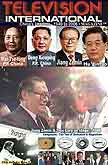
the Shanghai TV
Festival In
October1988,
as
a member of the
Political
Bureau of the
CPC Central
Committee
and as the
Mayor of
Shanghai,
Jiang
Zimen
played host to
the Shanghai
Television
Festival. The
Opening Night
show became the
first TV Show
to be
nationally
televised to
over 300
million viewers
throughout
China. The Troy
Cory Show,
featuring Troy
Cory, Joey
Adams and the
West
Side
Boys
were
highlighted on
the
international
program.
After
that event --
it was he and
Deng Xiaoping
and STV's great
staff of
workers
willingness to
take a chance
with our
"lively" show,
says Troy Cory.
"It was their
warmth and
willingess to
allow the
publishers of
TVI Magazine to
hand out its
American
magazine at the
Festival,
opening the
door for myself
and many of my
"ChinaExpo2000"
associates in
America -- to
commence doing
business in
China. Of
course, since
that time, it
was Jiang who
hosted the
successful
visit to China
made by Vice
President Gore
and President
Clinton, and it
was Jiang who
also oversaw
the peaceful
handover of
Hong Kong back
to China in
July
1997."
|