FREE USE OF
CONTENTS:
This Web
page is about saying thanks to all of our
Yes90 blogger team who have helped us put
the Smart-Daaf Boy, Yes90 TimeLine
together. The use of the contents on this
page can be used at no cost to Web users
for Educational and Historical purposes
under Yes90/109 Authority and TVI
Magazine, Publisher/Editor. Credits For
Use should read: "Smart-Daaf Boy Data or
NBS100.COM TeleCom Study" - Thanks Again.
- MORE
ABOUT: Content Clearance
FREE
USE of
the contents on this page can be used at
no cost to web users.
CLICK FOR
RULES
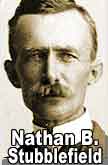
Nathan B.
Stubblefield (November 22, 1860 -
March 28, 1928) was an American inventor
and Kentucky-born Educator and founder of
Teléph-on-délgreen
Industrial School..
Teléph-on-délgreen, built on
his 85 acre melon farmland is now the
campus of Murray State University, Murray,
Kentucky. The peaches, apples, watermelons
and other crops that Nathan
Stubblefield grew on
Teléph-on-délgreen, were not
only a source of pride, but it was the
watermelon that held special symbolism to
his EMW RF inventions, and All-in-One
Radio Patent, 1908.
The Nathan B. Stubblefield 1892 Wireless
Telephone system, hereinafter,
called NBS WiFi, or simply NBS, had at
least for a while, a few advantages over
and above his wireless conpetitors. The
big difference between his and theirs, NBS
could send voice, and the Edison, Tesla,
Marconi, and Fessenden transmiters
couldn't.
To compete against their existing patented
EMW spark induction coils that doubled as
both an aerial and a transmitter of
dampened or spark EMW RF signals, NBS was
granted U.S. Patent for the electrolytic
earth battery coil patent in 1898.
What made the little NBS earth
electrolytic coils so unique, was when
they were attatched to a grounded aerial
they could imitate and do the same
multi-RF tasks as the Edison, Tesla, and
Marconi, spark coil devices.
Also what made the NBS induction coil so
sensible, was the broadcaster didn't need
the required tall100' mast tower, and
extraneous motor, (generator) system to
supply the high voltage current needed to
power their induction coils to produce the
RF spark signals emitted in space.
As it turns out, when his inert loop
antenna sitting above or near his physical
telephone microphone and speaker device
became energized by his EMW grounded
electrolytic patent, it became annimated.
His Wireless Telephone was then
ready for one way broadcasting, or could
act as a two-way wireless WiFi telephone
device, with options. (See to top
photo).
This unique set-up backboned his separate
and distinct scientific method of
transmitting RF voice signals through
space between land Vehicles,
ship-to-shore, moving trains, and office
and residential telephone customers, with
land-line telephone pole connections.
CLICK
MORE ABOUT: Loop Antenna. See
Photo.
Today 100 years later, Cell Phone and WiFi
Internet users still transmit articulate
RF WiFi voice signals, as indicated in his
1908 patent drawings. The Wireless
Telephone RF transmitter/receiver,
was designed to utilize both the air waves
and land-lines, to reach the telephone
subscribers -- or one-way Wireless unit
with a speaker system. - Continue
For More
1.
Feature
(Excerpt
from)"The
SMART DAAF BOYS"
Continued
from above -
Because NBS knew he was living in a
copycat EMW world, he did something no
other inventor would ever do, he agreed to
invite all of his competitors to his 1902,
Washington, D.C. - Philadelphia
Demonstrations, to meet top Washington and
Kentucky officials. Not only did they all
show, but the government officials from
the U.S. Patent Office, Signal Corps, the
co-founder of General Electric, Edwin
Huston, Westinghouse, Tesla, Fessenden,
and Collins were all there witnessing the
first Wireless Telephony ship to shore
broadcast.
Four years later, on Christmas Eve, 1906,
the GE, Alexanderson - Fessenden team
reported to have accomplished the same
feat. Whereas Stubblefield used a battery
system to power his uninterrupted voice
broadcast, Fessenden used the GE
Alexanderson designed generator to power
his antenna system. Max Wien's technique
of muffling spark gaps by quenching spark
gaps prior to microphone activity and
during spark gap transmission, made his
broadcast possible. This was not a public
demonstration. CLICK
MORE ABOUT: Demonstration. See
Photo.
Nine
Years Before Marconi mastered sending
-- Dit dahs in his back yard, and
while DeForest was studying at Yale, as
early as 1885, Nathan B. Stubblefield, the
owner and inventor of his own telephone
company; and telephone system; --
developed a way to transmit the voice by
CW, as much as three miles-- by means of
his patented "earth battery."
---- By
allowing electricity to flow in one
direction only, these little coils
converted the very rapidly alternating
radio-frequency wave into a series of
pulses whose variations in strength,
(amplitude) --were in the audio-frequency
range to which earphones and the human ear
could respond. By 1892, he was
broadcasting voice -- and selling his
receiver to his customers and local
businesses. CLICK
FOR MORE ABOUT NBS AND HIS LIFE AND
STYLE. 02
/
TimeLine
- 1882 - 1931 / N.B. STUBBLELFIELD,
and the
original Smart-Daaf Boys / Edison Patent
Holders, Public Demonstrations, World
Events & Their Fate.
1868
to 1881CLICK
FOR MORE NBS100 Telecom FCC STUDY and
TimeLine
1882 - 01 Nathan B.
Stubblefield demonstrated his ability to
send a signal across the Murray Courthouse
Square without wires. Note: Nathan's
wireless signal moved the needle of a
compass from north to south, to east-west,
the area where Nathan was standing with
his transmitter.
1882 - 03 Edison developed the first
central electric light power
station.
1882 - 05 Professor Amos E. Dolbear
was able to send signals over a distance
of a quarter of a mile without wires. Note
that Prof. Amos Dolbear preceded Hertz and
Marconi.
1885 -
Grover Cleveland: 1885-1889.
1885 -
From 1885 to 1913, Stubblefield
invented, developed, manufactured and
sold, both his wired mechanical telephone,
and his wireless telephone systems through
his own companies, partnerships or
corporations he owned shares of stock
in.
1885 -
In 1885, Stubblefield reportedly
succeeded in sending voice between two
parallel antennas by utilizing the same
principles Ward and Loomis developed in
sending damped signals but via a
low-frequency undamped electric wave
dispersion system. It was limited in
distance, but wireless (needs supporting
citation).
1885 -
The
Stubblefield Coal-Oil-Lamp Lighter, Patent
No. 329,864, dated November 3,
1885.Click
to Go To U.S. Patent Office -- then Click
Full Text to refresh
page.This
was the first of four patents filed by the
25 year old, Nathan B. Stubblefield of
Murray, Kentucky. 1885
- 1913 - The companies Stubblefield
was involved in were the NBS Enterprises,
The Wireless Telephone Company of America,
The Gehring-Fennell-Stubblefield Group,
The Continental Wireless Tel & Tel
Company, The Collins Wireless Telephone
Company, and
Teléph-on-délgreen (citation
needed).
1886 -
Nine years before his contemporaries,
Marconi, Tesla and Fessenden mastered
sending Dit Dahs, (the Morse Code), Nathan
Stubblefield was the patent holder and
owner of his own telephone company,
(1886).
1886 -
Professor Amos Dolbear of Tufts
College obtained a patent for an induction
method of wireless
telegraph. 1887 - German
physicist Heinrich Hertz first
discovers Radio Waves. He transmitted an
electrical spark which was heard in a
receiving circuit a few meters away, thus
the term Hertzian Wave. Hertz demonstrated
that the velocity of radio waves equaled
the speed of light. The unit of frequency
was named in his honor. 1888
- The
Stubblefield Mechanical Telephone Patent
No. 378,183, February 21,
1888.Click to Go To US Patent Office --
then Click Full Text to refresh page.
Nathan B. Stubblefield and Samual
Holcome patents their mechanical
"vibrating" telephone system. The first
permanent mechanical telephone
installation was in Murray, Kentucky to
demonstrate and sell franchised telephone
rights or territorial deeds around the
United
States.
1889 - Larynogophone:
Nathan B. Stubblefield - In 1889,
Stubblefield developed what was to have
been an improvement on his mechanical
telephone, and he renamed the device the
"Larynogophone." It was basically the
original mechanical telephone but with a
hearing tube and a bell added to his
copper wired telephone system that emitted
Sideband Electromagnetic Waves. 1892
- First Wireless Telephone Broadcasting
Demonstrations:
(Voice)
Nathan B. Stubblefield's first public
"wireless telephone" demonstration was
given in the town square of Murray,
Kentucky, a radius of about one half mile.
By connecting his telephone
apparatus to his newly invented
electrolytic coil earth battery -- he
transmitted and detected continuous
undamped electromagnetic waves, at a
radius of about one half mile;
Using
his grounded bare wired aerial system
connected to his loop coil antenna, placed
on top of his receiver -- he was able to
talk back and forth "without wires" to
others with a like telephone and loop
antenna, or broadcast voice and music to
those listening through a mono-earphone
piece; (The so-called Hertzian Wave, was
produced by coils that emitted sparks, and
could not transmit voice signals).
Rainey
T. Wells, who later became the founder and
president of Murray State University, was
one of the first persons to hear
Stubblefield's wireless voice
transmissions. Rainey became his assistant
in the 1892 exhibit. The public exhibits
demonstrated Nathan's;
1. Own Aerials;
2. Own Inductive Coupling To The
Aerial And Ground Circuits;
3. Own Tuning Coils and Detectors, to
Obtain the Desired Wavelength, and;
4. Employed his own power source
emitted from the earth that acted both as
a "hot spot" to transmit a continuous flow
of electricity to power his transmitter
signals through space, and as an unlimited
supply of electricity that simulated a
charged-up battery, ready to be used at
will. *(See Footnote.) Ice House. *
1892
- The first permanent wireless telephone
broadcasting installation was in January,
1892.The station was constructed in Murray,
Kentucky, by Stubblefield's
Teleph-on-del-green Industrial
College, now the campus where Murray
State University is located.
1894 - 02 The first
permanent wired telephone exchange
switchboard installation in Murray,
Kentucky, was on February 12, 1894. The
telephone service was constructed in
Murray, Kentucky, by the Nathan
Stubblefield Telephone Manufacturing Co.,
in the town square to work in conjunction
with his wireless telephone operation.
1894 - Heinrich Hertz
dies in January.
1893 -
Bell Telephone patent expires.
1894 -
The first permanent wired telephone
exchange switchboard installation in
Murray, Kentucky, was on February 12,
1892.The telephone service was constructed
in Murray, Kentucky, by the Nathan
Stubblefield's Telephone Manufacturing
Co., on the town square to work in
conjunction with his wireless telephone
operation.
1895 -
Wireless Telegraph Demonstration:
(Dit dahs
- no voice)
Guglielmo Marconi - In the spring of 1895,
what Nathan B. Stubblefield did with
wireless voice transmission in 1892,
Guglielmo Marconi did with dots and dashes
utilizing damped electromagnetic waves
emitted by his Ruhmkorff coils (see 1897).
He discovered that his "black box"
utilizing the Ruhmkorff coil, could send
controlled messages, by touching two
electrically charged wires together in a
dit dah manner - over distances far
greater than those from his villa to the
garden -- distances which would travel
more than a mile. It was Marconi's great
basic invention. Like Stubblefield, he
built an aerial -- an antenna which he
connected to one side of the spark gap.
(Hertz had merely used a horizontal rod
ending in a plate). The aerial was a metal
cylinder atop a pole. He connected the
other side of the spark gap to a ground --
at first, a copper plate lying in the
ground. The receiver also got an aerial
and ground.
1897
0713 - Transmitting Electrical Signals by
Ruhmkorff Coil Patent -
(Dit
Dahs, No
Voice)
- Guglielmo Marconi, Electromagnetic
Spark Transmitting
apparatus,
was granted
on July
13, 1897, United States Patent No.
586,193.Click
to Go To US Patent Office --
then
Click Full Text to refresh page.
The apparatus could transmit
damped electromagnetic waves, utilized a
Ruhmkorff coil. (see - 1895). The
first permanent wireless telegraph
installation was constructed at The
Needles on the Isle of Wight, Great
Britain, by Marconi's wireless Telegraph
Co. Ltd, in November 1897.
1898 - 0404 April.
Newspaper demands WAR WITH SPAIN. The
Hearst, New York Journal issued a million
copy press run dedicated to the war in
Cuba. The newspaper called for the
immediate U.S. entry into war with Spain.
"The war of the United States with Spain
was very brief. Its results were many,
startling, and of world-wide meaning."
--Henry Cabot Lodge 19 March.
1898 - 0420 April - U.S.
President William McKinley signed the
Joint Resolution for war with Spain and
the ultimatum was forwarded to Spain.
Spanish Minister to the United States
Luís Polo de Bernabé
demanded his passport and, along with the
personnel of the Legation, left Washington
for Canada.
1898 - 0421 April - 21
April. The Spanish Government considered
the U.S. Joint Resolution of April 20 a
declaration of war. U.S. Minister in
Madrid, General Steward L. Woodford
received his passport before presenting
the ultimatum by the United States.
1898
0508 - Wireless Telephone Transmission
Coil Patent - United
States Patent No. 600,457, Granted May 8,
1898.Click
to Go To US Patent Office -- then Click
Full Text to refresh
page.PATENT WAS ISSUED TO STUBBLEFIELD FOR
the ELECTROLYTIC COIL. The Patent was
referred to as the: Electrolitic Water
Battery, the Electrolitic Oscillating
Coil, the Induction Coil, Earth Battery,
Undamped Transmitting Coils, The
Stubblefield Electrolytic Detector.
Stubblefield's
grounded bare wired Antenna System was
part of his system to transmit continuous
voice or telegraph signals without wires
through a single aerial tower. The first
permanent wireless telephone broadcasting
installation in the world, (the precursor
to AM Radio) -- was erected by
Stubblefield's Teleph-on-del-green
Industrial College, in January, 1892. The
location is now part of Murray State
University, Murray, Kentucky, U.S.A. The
transmitter and receivers were usually
placed 200 feet apart for demonstrations.
The electromagnetic coils were also the
precursor for today's "Firewire" and
battery operated implants in today's world
of broadband streaming video and
electro/heartstimulus
technology.
1899 04- In April the
Spanish American War was over. The Queen
regent of Spain, María Cristina,
signed the Treaty of Paris, breaking the
deadlock in the Spanish Cortes; Spanish
forces at Baler, Philippine Islands,
surrendered to U.S in June.
1899
1110 - AMERICAN WIRELESS TELEPHONE
& TELEGRAPH CO. - The First Wireless
Telephone Company Established In America.
The American Wireless Telephone &
Telegraph Co., was incorporated under the
laws of the territory of Arizona on
November 10, 1899, with a capitalization
of five million dollars. Dr. Gustav P. -
Gehring Group Of Companies, was the
founder.
1899 -
1230- The American Telephone And
Telegraph Company - AT&T - Replaces
The American Bell Telephone
Company.
1900 -
PATENT EXPIRES: Thomas A. Edison's
1883 Edison Effect Patent.
1900 -
PATENT: Guglielmo Marconi Was Issued
His Famous Patent 7777 - (Patent Expires
In 1917) - England. (Note: Stubblefield's
1898 held patented rights For Electrolytic
Ground Connections To Antenna).
1901
08 - Wireless Telegraph Co Of America
- August 8, 1901, New Jersey,
Incorporated, $3.000. (A Gehring
Company).
1901
12 - Marconi claims first Transatlantic
telegraph signal (Dit Dahs), during
private demonstration - Guglielmo
Marconi, George Stephen Kemp and Percy
Paget. - It was near noon on December 12,
1901, when Marconi himself heard the
letter "S" being transmitted from a 10kw
station at Poldhu, Cornwall, Great Britain
to Signal Hill, St. John's, Newfoundland,
Canada. Note:
Only Marconi heard the "S."
1902
01 -
Stubblefield
claims the leader of wireless telephone
broadcast
(Voice)after the second of four public
wireless telephone demonstrations held in
the U.S. The demonstration was held on
January 1, 1902, -- 21 days after the
Marconi "S" was transmitted,
Stubblefield's first public wireless
telephone demonstrations was in 1892, (see
- 1892). The St. Louis Post Dispatch on
Sunday, January 12, 1902 headlined the
Stubblefield event as: "Kentucky Farmer
Invents Wireless Telephone". The broadcast
took place in the town square of Murray,
Kentucky, utilizing Stubblefield's
electrolytic grounded and groundless
antenna system. The wireless telephone
transmiter and receivers were placed 200
feet apart within a radius of about a mile
and one half listening to the same voice
broadcast.
1902
03 - Stubblefield's - World's First
Ship To Shore Radio Wireless Telephone
Broadcast -
Washington, D.C.
Demonstration. On March 20, 1902,
Stubblefield set up a demonstration on the
Potomac River in Washington, utilizing his
"groundless antenna" connected to the mast
of the ship.
1902 -
Stubblefield's Wireless Telephone Company
Of America - Incorporation Papers -
Filed In Prescott, Arizona, on May 22,
1902. Gehring, Stubblefield and Fennell,
incorporated their new company in the
State of Arizona, 75% of the Collins'
Wireless Telephone Company was given to
Stubblefield, for the patent rights in
Canada.
1902
05 - Stubblefield's - Philadelphia
Wireless Radio Telephone Demonstration -
On May 30, 1902, just a little
over two months after this Washington
Demonstration, Stubblefield gave
demonstrations of his wireless telephone
in Philadelphia at the Belmont
Mansion.
1902
06 - Stubblefield's Philadelphia
Wireless Telephone Demonstration -
On June 7, 1902, Stubblefield again
demonstrated his apparatus in
Philadelphia. This test took place on the
banks of the Schuylkill River, from the
Belmont Pumping Station To The
Pennsylvania Railroad Bridge, a distance
of about one and one half miles. --
Miller.
1902
0611 - Stubblefield's New York
Demonstration - is held jointly
with his Wireless Telephone Company Of
America - to show case his newly designed
aerial and speaker system apparatus In
Battery Park, New York City. What is the
Relevancy of Stubblefield's wireless
telephone to the Internet? In this
exhibit, again, one of the transmitters
was connected directly to the local
telephone company's switch board for mass
party-line broadcasting.
1902
0702 - Ship To Ship Demonstration -
Frederick Collins - on July 2,
1902, for Erie Railroad. Used the same
Stubblefield Wireless Radio Telephone,
Stubblefield used in the March 20th
Potomac demonstration, utilizing Collins'
marine designs.
1902 - July 19th 1902,
Philippine War officially ended in the
Philippines, with more than 4,200 U.S.
soldiers, 20,000 Filipino soldiers, and
200,000 Filipino civilians dead.
1903 -
Wright Brothers Orville and Wilbur,
fly the first motor power-controlled,
heavier-than-air plane at Kitty Hawk,
N.C.; Maj. Squire, first passenger; Henry
Ford organizes Ford Motor Company.
1903
0501- COLLINS MARINE WIRELESS
TELEPHONE CO., THE - Formed in May 1903.
1903
12 11 - PATENT EXPIRES: Wireless
Telegraph - Induction; Emerson Amos
Dolbear's 1986 Wireless Telegraph-
Induction Patent expires.
1904
0201 - Stubblefield 's Groundless
All-in-One Radio System completed
February, 1904.
1905
to 1910 1905
02 -AUDION PATENT Number One,
#979,275, was Applied For On February 2,
1905 - By De Forest.
1905 -
PATENT LAWS - Revised (1905, STATUTE: SEC.
4886).
1906 - 27 nations signed
the International Wireless Telegraph
Convention in Berlin.
1906
12 - Ship To Shore Christmas Eve
Broadcast With GE Alternator (Christmas
Eve) Reginald Fessenden and Ernst
Alexanderson. Occurred the same year
Tesla's Westinghouse patent for his
60-cycle electrical generator
expired.
1907
0228 - THE FIRST RADIO STOCK
CORPORATION. De Forest RADIO TELEPHONE
COMPANY - On February 28, 1907 - the first
Wireless Telephone company USING the new
WORD
"RADIO."
1907
0405 - Stubblefield In Washington.
Nathan B.
Stubblefield's Wireless Telephone Patent
Application Filed Apr. 5, 1907, Serial No.
366,544 -Room 109.
The first permanent
wireless telephone broadcasting
installation was in January, 1892. The
station was constructed in Murray,
Kentucky, by Stubblefield's
Teleph-on-del-green Industrial College, on
the campus where Murray State University
is now located.
1907
0601 - June 1, 1907 - STUBBLEFIELD NBS
PROSPECTUS -
VALUABLE APPLICATIONS OF THIS INVENTION.
As Cited In Our United States Patent
Application.
1907
0607 - Private NBS Prospectus -
June 7, 1907 -
U.S. Army Signal Corps - Major Squier,
Washington, D.C.
1907
1017 - Stubblefield Wireless Telephone
Patent Application
Approved by
Commissioner Allen - Nathan B.
Stubblefield - (Patent Expires October 17,
1924).
1908 12 -
Antenna PATENT EXPIRES: Thomas A. Edison's
Antenna - 1891 filed Wireless Telegraphy
Patent Expires.
1908
0512 - PATENT:
Stubblefield
Received His All Purpose - Wireless
Telephone Patent, Number
887,357Click
to Go To US Patent Office -- then Click
Full Text to refresh page.
- (Patent Expires May 12, 1925)
1908
0218 - PATENT: Audion Patent Number
Three, #879, 532 Covering The Device As A
Detector - Was Issued On February 18,
1908, to De Forest.
1908 - 12 Antenna PATENT
EXPIRES: Thomas A. Edison's Antenna - 1891
Wireless Telegraphy Patent Expires.
1909 - William H. Taft:
President / 1909 - 1913.
1909 - CONTINENTAL
WIRELESS TELEPHONE AND TELEGRAPH COMPANY,
formed: Included six companies. (Wireless
Telegraphy or Wireless Telephony):
Incorporated December 1909 in Arizona For
$5 million.
1909 0417 -
STUBBLEFIELD'S
CANADIAN PATENT Issued #114,737
- GRANTED TO STUBBLEFIELD - (Patent
Expires in 1926).
1909 0615 -
Stubblefield
Assigns Canadian PatentTo A. Frederick Collins, June 15,
1909. Collins assigns 75% of his old
Collins Wireless Telephone Company Formed
in 1903.
1909 - Marconi is
awarded the Nobel Prize for Physics.
1909
1114 - A. Frederick Collins -
Electrical Show In Madison Square Garden,
New York, Oct. 14, 1909 for the purpose of
selling stock in the Collins Wireless
Telephone Co.
1910
to 1916 1910 -
Mann-Elkins Act - Congress first
vested federal regulatory authority over
telephone services in the Interstate
Commerce Commission, under this Act of
1910. This followed the practice of local
franchising initiated by states and
municipalities to control rates and
service quality.
1911 -
COLLINS INDICTED - December 1911. Four
officers of the Continental Co. excepting
Walter Massie were indicted for using the
mails to defraud in selling worthless
stock.
1911 -
CONN LINN - RESIGNS FROM THE KENTUCKY
SENATE, and leaves Murray Kentucky,
for Oklahoma.
1911 -
De Forest's RADIO TELEPHONE COMPANY -
BANKRUPT IN 1911, when it expired
owing to De Forest's inability to raise
further funds.
1911 -
0101 -GEORGE O. SQUIER - PATENTS -
(Patents Expire 1928) - All of his
discoveries and inventions -- some shared
with Stubblefield, worth millions -- were
patented in the name of the people of the
United States on January 1,
1911.
1911
05 -United Wireless Trial - May 17, 1911 -
Bogart pleads guilty.
1911
0723 -United Wireless -Bankrupt. On
July 23, 1911, United Wireless was
adjudicated bankrupt in the Courts of
Maine, and on September 15, 1911, Trustees
in Bankruptcy were appointed.
1912
03 - A Warrant Was Served De Forest For
His Arrest In March, 1912 - on a
federal indictment charging him with use
of the mails to defraud in connection with
sales of stock in the most recent four of
his radio telephone companies.
1912
0325 - United Wireless Co. - In March,
1912, United Wireless Pleaded No contest -
and was taken over by the British
Marconi Co. for the payment of $700,000.
The company was immediately sold to
American Marconi.
1912
0325 - MARCONI WIRELESS TELEGRAPH CO. VS.
UNITED WIRELESS TELEGRAPH CO. -
Creates a Merger .
1912
1210 - PATENT:
Stubblefield Flying Machines U.S. Patent,
#1046895, December 10,
1912;Click
to Go To US Patent Office -- then Click
Full Text to refresh page.
Letters
Patent granted Stubblefield for 17 years
from December 10, 1912 (expired Dec. 10,
1929).
1913 -
The "Kingsbury Commitment."
- American Telephone and Telegraph
(AT&T) began buying up rivals. But
AT&T's acquisitions troubled federal
authorities, which began considering
antitrust action. This prompted AT&T's
company officials to propose, a
self-serving anti-monopoly unit, that
subsequently became known as the
"Kingsbury Commitment." On December 19,
1913, AT&T agreed to sell $30 million
of its Western Union stock and to allow
competitors to interconnect with its
network. The company also pledged that for
every new local system acquired, it would
sell an equal share of lines to rivals.
The Kingsbury Commitment was wholly in
keeping with the monopolizing of both
wired and wireless strategy of
AT&T;
and the preserving of consumer confidence
by the use of Takeovers; Buyouts; and
mergers of troubled competitive
"look-a-Likes".
1913 -
Collins And Four Officers - Convicted
On All Five Counts For Stock Fraud.
Three were fined and sentenced on January
10, 1913, to prison terms of up to four
years. (Please see 1911, Continental).
1913 -
COLLINS WIRELESS TELEPHONE COMPANY -
Dissolves.
1913 -
PATENT EXPIRES: Nikola Tesla's 1896
Synchronous And Non-synchronous Rotary
Gaps Patent Expires.
1913
07 - De Forest Sells Audion Patent
Rights To AT&T - For $50,000.
1913
1230 - De Forest - Fraud Trial Of DeForest
Ends - Darby and De Forest: nolle
prosequi, meaning that the charges had
been dropped.
1914 -
PATENT EXPIRES: Marconi's 1897
Wireless Telegraphy Patent (First
Patent) Expires.
1915 -
AT&T - SQUIRE - Single Sideband -
The original development of single
sideband came about because of certain
limitations in radio telephone circuits.
Experiments were first conducted by Nathan
B. Stubblefield and Major Squire in 1908,
and then Squire and John R. Carson of the
Bell Research and Development Labs, and
the American Telephone & Telegraph
Company in 1915.
1915
0508 - PATENT EXPIRES: Patent
For Stubblefield's Electrolyte Battery And
Radio Voice Detector And Transmitter,
(Wireless Telephone) Expires.
Part
02
For
More Go To 1916 to
1934
1916
- PATENT EXPIRES: Thomas Edison's 1891
Patent For Antenna Wireless Telegraphy
- Expires.
1917 -
PATENT EXPIRES: Marconi's Famous 1900
Patent 7777 Expires, Ends The
Prevention Of:
1. Use Of Aerial And Ground.
2. Inductive Coupling To The Aerial
And Ground Circuits.
3. Use of Tuning Coils to Obtain
the Desired Wavelength.
4. Employed the Electrical Energy
Of The Earth As A Battery.
1917
0406 - U.S. Declared War On Germany On
April 6, 1917 - Tuckerton Station staff
members were arrested and sent to a
prisoner of war camp in Virginia. All
Commercial And Amateur Wireless Stations
Were Closed - or came under Navy control
on April 7, 1917, when war was
declared.
3.
Editor's Note / For
More Go To NBS 1925 to
1934
1925 -
De Forest's 1908 Audion Patent Number
Three, #879, 532 Covering The Device
As A Detector, Expires.
1925
0512 - Patent Expires:
Stubblefield's 1908 Radio Patent Expires,
May 12, 1925.
For
More Go To NBS 1928 0328 -
DEATH
OF NATHAN B.
STUBBLEFIELD, and the end of his dream, the
National Broadcasting System, "The
Inventor Of Radio" (Wireless Telephony)
died in Murray, Kentucky on March 28,
1928. He is buried in the Bowman family
cemetery, located in back of the Walston
property, known as, 1619 N. 4th Street,
Murray, KY.
MAXWELL'S
ETHER THEORY DIES - November, 13,
1931. The one-hundredth anniversary of
Clerk Maxwell's birth was marked by the
scientific world "digging a grave for the
theory of a luminiferous ether," but at
the same time honoring Maxwell's
mathematical genius.
1934
-Congress created the Federal
Communications Commission in
1934.
03
Editor's Patent Notes
----It is now
assumed, that after his public
demonstrations in 1892 and 1902, in
Murray, Kentucky and later on the Potomac
River in Washington, D.C., the SMART-DAAF
BOYS and the rest of the world would have
become aware of his feats -- to send voice
without the use of wires.
----
The radio voice demonstrations made
by Stubblefield, were made 14 years before
Alexanderson and Fessenden's, 1906 radio
demonstration. Stubblefield used his
electrolytic transmitting and detector
devices, (his ground batteries) to relay
-- his radio signal, as Fessenden did with
his own "exciters" -- and AT&T did
with Maj. Gen. Squier's multiplex, wired
wireless system and 29 relay stations,
(Please see Figure 3.19). Stubblefield ran
his largest transmitter at approximately
250 meters.
---- At
times, to extend the distance of his
broadcast, he would secretly bury a string
of his "earth" ground electrolytic
transmitter/detectors -- to relay his
signals. In short, he was modulating the
ground's electrical potential, changing it
from an electrical "sinkhole" -- to an
electrical transmitting source as an
engineer would do at any modern-day, AM
transmitter antenna site.
Before his 1908,
"All-in-One" patent was issued, (that
granted him the rights for both
Hi-frequency and Wired Wireless or
Guided-wave system for the use of
broadcasting to all moving vehicles, ships
and trains) - he was asked to describe the
differences in his transmitting stationary
aerial; the horizontal aerial having its
opposite stretches or sides extending
along the opposite sides of the path of
travel of the vehicle; and the loop
antenna coil attached to the vehicle -
from other patents.
---- He
simple explained to the patent examiners
of the impossibilities to broadcast radio
waves with their coils, because, as he put
it, they did not have the proper wire, and
would have died from "high frequency
kickback". High frequency quickly heats
insulation. [Editors Note: A microwave
oven works on the same principle. In a few
minutes, the insulation inside the
generator or coil grew so hot, that the
coils caught fire.]
What saved the day in
the granting of the patent on his 1908
wireless telegraphy system, was the
transmission coil described in his 10-
year-old, 1898 "earth battery" patent. It
should be also noted, that Stubblefield's,
loop "antenna" was covered within the
patent. The loop antenna was designed to
be used with radios installed in moving
vehicles that could not be grounded, such
as: airplanes, ships and automobiles.
----
Residents and customers of
Stubblefield's telephone company, in the
small town of Murray, used similar
wireless equipment in their business
telephone service and wireless burglar
alarm systems -- installed by Stubblefield
since 1895.
---- The
United States Army and AT&T first used
the combined system during World War I, to
guarantee articulate voice reception; if
the transmitting aerial was knocked out,
the wired wireless system would continue
to operate until the aerial could be
repaired.
The First Wireless
Telephone Company to commercially exploit
the invention, was established in 1902,
and folded in 1927. Stubblefield became a
stock holder, officer and director of the
Wireless Telephone Company of America.
---- It is
obvious his demonstrations in Philadelphia
and Washington, D.C., created more
interest in the device from the SMART-DAAF
BOYS and stock promoters, than history
books. Yet it is here that we realize that
the following SMART-DAAF BOYS were the
ones that perfected Stubblefield's basic
principles of AM radio broadcasting, as we
know it today.
MAXWELL'S
ETHER THEORY DIES - November, 13,
1931. The one-hundredth anniversary of
Clerk Maxwell's birth was marked by the
scientific world "digging a grave for the
theory of a luminiferous ether," but at
the same time honoring Maxwell's
mathematical genius.
4.
Related
Stories
/
For
More Go To 1916 to
1934
1916
- PATENT EXPIRES: Thomas Edison's 1891
Patent For Antenna Wireless Telegraphy
- Expires.
1917 -
PATENT EXPIRES: Marconi's Famous 1900
Patent 7777 Expires, Ends The
Prevention Of:
1. Use Of Aerial And Ground.
2. Inductive Coupling To The Aerial
And Ground Circuits.
3. Use of Tuning Coils to Obtain
the Desired Wavelength.
4. Employed the Electrical Energy
Of The Earth As A Battery.
1917
0406 - U.S. Declared War On Germany On
April 6, 1917 - Tuckerton Station staff
members were arrested and sent to a
prisoner of war camp in Virginia. All
Commercial And Amateur Wireless Stations
Were Closed - or came under Navy control
on April 7, 1917, when war was
declared.
For
More Go To NBS 1925 to
1934
1925 -
De Forest's 1908 Audion Patent Number
Three, #879, 532 Covering The Device
As A Detector, Expires.
1925
0512 - Patent Expires:
Stubblefield's 1908 Radio Patent Expires,
May 12, 1925.